Decoding Gardening Advice by Jeff Gillman and Meleah Maynard

Advice – it comes from friends, family, and from the stranger at the coffee shop, or at the garden shop where you are looking at plants, and among that free advice are some gems and some duds, the fun part is always been to figure out which are which by trial and error.

I remember asking “why” as a child and teenager when my mother would show me the proper way to do something, and the answer often was, because that is how I was taught and it works.  The how and why it worked were often left unanswered, as if it would just happen by magic.

Life has moved on and I still find myself often asking questions on “why” should we do this or that, and what makes that works so when Decoding Gardening Advice, The Science behind the 100 most common recommendations crossed my desk, I devoured it, then read it again, then thought about it and went back for a third reading. This book is done in seven sections, covering everything from soil and water to vegetables and fruit along with more basic sections that the average home owner would find useful in lawn care. This is an information-heavy book, with very few photos or charts.
Each chapter has a listed section on, Good Advice, Advice that’s debatable and Advice that’s just wrong.  The perk of this should be clear, its perfect for someone like my hubby who does not want to read the whole book or chapter, he just wants the answer and to go.

Where for me, I like that it takes the “idea” and then breaks it down into the basic science and explains why it would or would not work or in many cases, why it would work to a point, but I wish they had provided a bit more information in regards to where the science source came from.

I really enjoyed the fact that this book did not try to make everything black and white, yes or no answers. As gardeners we know there is wiggle room in many things, and the authors of this book understand this and addressed it in a way I really liked.

If they were dealing with a debatable idea, they not only shared the science behind it but they went one step further and would share how to take that idea and give an even better way to do it.

I have to admit that I don’t think that the authors are quite as eco-friendly as I would prefer for my own lifestyle choices but they give their reasons in a clear manner.

Highly recommend this book for new gardeners, the advice given by friends, family and online can be overwhelming, this book will help you save time and money in figuring out what advice to put to use in your garden.

Posted in Book Reviews | Tagged , , , , , | 5 Comments

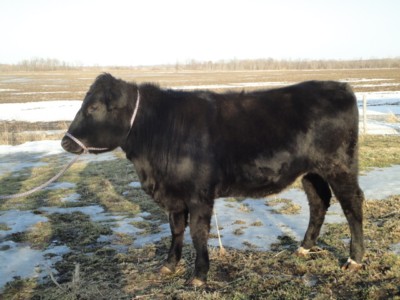
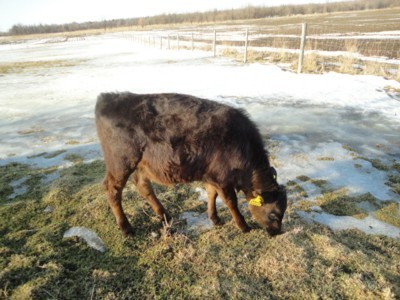
March Challange 4th- I love my draft cow!

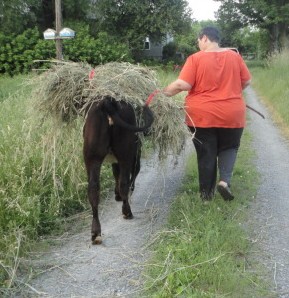
The weather is better today but I needed to do more hauling and the drifts are wicked to say the least, I had let Girl out to feed at the big hay feeder and then looked at her, and thought.. hmm, went an grabbed some of her basic gear and had her help me haul the sled up and down six times from the front yard to the barn, and then had her help me haul about two hundred pds of hay down to the barn and then roped the big 900 pd hay bale, and got her to help me flip it..  I am so proud of her, I wanted to help rock it, and so she was in a Woo and Stand.. and then pulled by VOICE command..what a good girl.. I certainly would not trust her outside a fenced yard to listen, as I know just how often I have to still correct a Wooo/Stand these days but she was already in “work mode” all total we went for more then 40 min, she got a bush down and a grain at the end.. I got less of a upper body workout but the legs are just a burning. She walks faster then I do.. I can’t wait for a proper stone boat this year, so I can either ride it or have it slower her down a bit.. Sorry folks, no photos from today, so I put up one from this fall when she was hauling hay, wow, I was just looking at her baby photos, she is getting so big!

Breakfast-Yogurt, strawberries/rhubarb, walnuts

Lunch- Hard boiled Eggs, and canned pears

Supper- Lamb Stew meat, onion, mashed potato’s with greens

Snack- Cinnamon Sugar Popcorn

Extra: Coffee, Herb Tea, Water,  Pickled Eggs(in the leftover Beet Pickle juice) Hard boiled a pot of eggs, harvested some greens, planted some seeds, and transplanted some onions into bigger single pots.

Given that I am talking about the cow today, I am going to stay on that topic.. and it leads me to… Plowing, and or turning the soil in your gardens..

Now I have read many books on the different schools of thought, till, no till, layer, make a raised bed, hugelkultur and the lists goes on.. I am not going to say which is right or not, I think each one has good points and each one has flaws to a point, so instead, I am just going to tell you what I do..

When I break ground, , I follow the trench digging method, this gives a dig down of about 12 to 16 inches overall, I never go deeper then that, I put good 3 to 4 inches of well done compost and then we dig and flip it, that puts the soil and compost at the bottom with the soil on top.. we try to do this in the fall, allowing the winter to heave and break the soil more for us and to provide snow cover.. if there is lack of cover, I will spread out a layer of straw, leaves or bedding with sheep manure on top..

In the spring, we tend to lightly chop and dig it in over the first four to six inches an then level it and cover crop it, some area’s are planted for the first year to loosen the soil, example growing burdock, stinging nettle, potato’s typically.. Once they are pulled out and dug out, it gets leveled down again, green cropped and or bedded down with cover.

I try hard to not have very much bare soil in the garden, it looks like a jungle and most folks who look at it think I have not weeded at all.. but the truth is I weed out any plants that I don’t eat, but I allow many “weeds” to grow that are used in the kitchen, and I love stepping on mints in the walkways, the smell is heavenly, the extra flowers being in the bee’s etc.

I admire photos of those folks that have neat, and pretty gardens that I remember from my youth, my gardens today produce thousands of pds of food each year but they are not pretty or orderly!

I use my chickens for light tilling and bug control, I use my ducks in the garden at certain times of the year for slug control as well as bug, the ducks don’t like the greens or make near as much of a mess of eating things I want for me, as the chickens do..

However the other thing we have added in for animal power over the years is piggy plows, they are allowed to dig up the deep packed bedding so that its light and fluffy stuff, it lets them express their desire to plow and dig, it allows us to have to work half as hard in the pens to move them around, and added bonus, it allows the compost to work even faster..

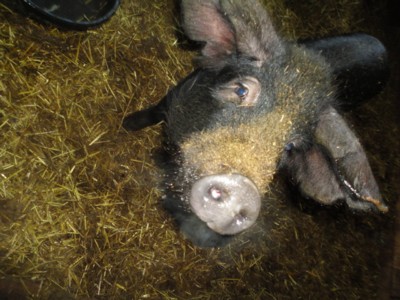
Angelo says, I might not think sqaush and onions peels and chicken shells are real food but I love to dig up the pen, mom’s got me working away in one of the birthing pens now that all the lambing for the year is done..  (Note, someone feels comfortable enough to look me in the eye now!)

Posted in March Challange | Tagged , , , | 4 Comments

March Challange 3rd- Garden-Mini -Zones

The winds are amazing today, and I have a few farm things to touch on before getting to my daily menu, and then on to my garden stuff.. So yesterday we had high winds, thankfully, very few things came down or was ruined in the wind, the big one being my huge purple martin bird house, its smashed beyond repair, and there are lots of little branches an a few med size one’s but overall, I am pleased with how the farm and buidings came though the very high winds we had.

The second thing of note is about the cows, Marty is now weaned, and I got to watch Girl do snow play, she was crazy about the new drifts and would lean down and play in them, she snow bathed her face and threw big peices in the air and had all kinds of fun with it.. I know that the hounds love to rub and roll in the snow but I honestly didn’t know that cow’s like to do so as well, I have never seen the sheep or goats do this.

Breakfast- Baking Powder Biscuit with a fried egg

Lunch- Roasted Chicken Sandwhich

Supper-Yogurt-Fruit-Almonds

Other-Water, Coffee, Mint Tea, Pickled Beets, Walnuts, Baked off Lamb Ribs, Shoulder Roast, and 2 pds of lamb stew meat, made fresh soft cheese.

Garden -Mini-Zones

The high winds had my nerves on edge yesterday and I tried to write a couple times but it just was not going to happen, I finally gave in and did my chicken sandwhich but as I checked and double checked things in the yard/garden, and my weights and tiedowns, it hit me.. Mini-Zones and wind patterns are a perfect topic for today..

When we are moving to knew places and or when we are planning gardens, we have a basic gardening zone given to us by the goverment, but that does not mean that is really all we have, we can naturally have an also create mini-zones, that are typically up to a full zone warmer then our typical zone is, on the flip side of that, you can have a low spot that will always get the first frosts..

Fences, buildings, and even different garden structures can all create mini-zones that you can take advantage of in where you choose to plant different things.

Then you can take things to the next level in creating mini zones by making instant cold frames, or row covers, these can make quite a difference to young tender plants in getting them started early or keeping productive plants going on the tail end of the garden season.

The big guns come out when you combine a cold frame that is topped with a hoop house, you can move a full two zones when you do it this way.

Posted in March Challange | Tagged , | 2 Comments

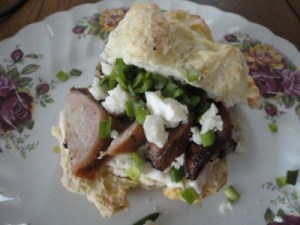
Farmgal’s Roasted Chicken Sandwhich.

Well, I would love to tell you that this is a quick and easy recipe and to point it is… when its put together..

This could be made with any good quality bread, I made mine with baking powder biscuits, I made a basic Garlic-Black Pepper mayo, diced up some fresh green onions, finely diced a half of a small onion, some crumbed sheep cheese, thigh of free ranged chicken, seared and oven roasted in duck fat.

Three days ago, I took my thighs with bone in and allowed them to thaw and rest in the fridge for 24 hours, then I brined them in salt/water for another 48 hours, at which point, I dried them, spiced them and seared them in hot duck fat, then into a hot oven for 20 min, then allowed to rest for five min covered in foil, sliced off the bone into thin stripes, the rest of the meat on the bone will be a treat to chew on later 🙂

I took the pan dripping and added the onions, and gave them a just till clear simmer,(if you meat is a little dry, drizzle a little of pan juices on them,  I put garlic mayo on both sides of the sandwich, the onions went next, then the meat, then the green onion and sheep cheese on top and voila.. This was such a wonderful yummy treat to have today after a morning of go-go-go on the farm, it was nice to just stop and savour the flavours, when you are used to store got chicken the first time you try, that darker, firmer and so much stronger flavour of chicken, you can’t help but want to create dishes around things all parts of it!


Posted in Food Production and Recipes | Tagged , , , | 4 Comments

March Challange Report -2nd

So the answer to am I going to go fix my mistake of not getting my last food buying is no, In the past if farm work, or weather meant that the you didn’t get to town, then they would not have been able to run to the store later in the middle of winter, so sadly, neither will I.

Doomer is joining in again this year, Check out her page and read about her first day and  her own personal rules for it.

Breakfast-French Cast Iron Baked No Kneed Bread 2 slices toasted, with 2 dippy pullet eggs, dried dill on top, fried in duck fat

Lunch-Homemade corn chili * See Recipe below with fresh sweet baking powder Biscuits

Supper- Baked Chicken legs in a spicy plum sauce,  homemade noodles with butter/galic/Chopped fresh onion greens.

Extras-Bread and Butter Pickles, Pickled Beets, Pickled Pumpkin, Coffee, Herb Tea, Water

Made today-Egg Noodles, Baking Powder Biscuits.

Sweet Mild Corn Chili Recipe

  • 1 pd of Ground lamb or any other ground red meat
  • 1 pint of home canned corn-Garden 2011
  • 1 quart of home canned tomato’s, onion, celery mix-Garden 2011
  • 1 pint of home canned Red Pepper Pasta Sauce -Garden 2011
  • 1 Pint of home canned pinto beans-Drained and rinsed
  • 2 tbsp of chili powder

Super easy to make, brown your meat, add the rest and heat though, serve and enjoy! – That’s what I call fast food!

Now on to the gardens, and as we were making chili, and one of the main things that makes a great chili, really good tomato’s..

Tomato’s, O my have you gotten some of the new catalogs, there are dozens upwards of hundreds now to pick from for the home gardener.. I tend to grow three main kinds in my own gardens, Cherry – for fresh eating and drying, Big beef stake type, -fresh eating, friend green tomato’s, green tomato jams, mock rasberry jams, Green Tomato stew and relish recipes. Roma or paste style -for canning and pasta making, limited drying.

On average for the two of us, we tend to plant about forty or so tomato plants, three to five cherry, a dozen of the big beef stack style and the rest into the paste tomato’s.

I have now for a number of years mulched my tomato plants, I start them off till at least four inches, then harden them off by the time they are six inches, for compost in the tomato area, I perfer to use a mix of year old sheep manure (about three inches or so in the spring mixed it) and a inch or two of mixed poultry manure (spread in the fall and left to settle and be mixed in during the spring when I do the rest), I tend to do a cool rabbit manure tea feed at least once in the late summer/early fall.

Once the soil has been feed, the plants go in, and the thick 6 inches layers of straw bedding goes down, I leave a small ring around the plants that do require weekly or bi-weekly weeding till they really get going, by the time they are a foot high, I need to get the cages around them, if you are using cages that have feet on them, put them at the same time as you plant out your six inch plants into the soil, but as most of mine don’t have feet anymore, this is no longer a issue.

My tomato plants are given dry land spacing, with means they get a min of 3 square feet per plant, and in the past couple years 4 sqaure feet of space, and boy do they need it, they have grown into a tomato jungle even with that spacing, pruning is required, pinch off the sucker branches.

I do water bath some basic tomato’s, with the use proper use of lemon juice, some of my tomato products are turning into sauces like BBQ etc  that have a high enough sugar/salt/vinager combo that they are also water bathed canned or they are pickled in the form of salsa with which has acid base allowing you to water bath can.. I would say that about 60 to 70% are done this way, the other 30 percent that are canned are pressure canned as a straight diced tomato or tomato/onion mix.

What is your favorite way to use them? Do you tend to go basic? Do you peel the skins? or do you use a machine that takes the seeds and skins off?

Posted in March Challange | Tagged , , , , , , , , | 2 Comments

Friday Food Storage -Feb $10 a week Food Challange overview

Well, the month is over and the march challange is on already, where has the time flown.

In regards to the last week of the Feb $10 a week challange, I didn’t get to spend my 10 dollars on the last week, so I have no photos to give, or update on that. I ended up at a seminar’s and J at the workshop and then the week just got away from us..

Things I learned on this challange, the biggest one is that we can very successfully eat well on only 10 dollars a week budget in regards to fresh food coming into the house. The only fresh things we got are all the basic’s and the storage from the farm, garden, cellar and freezers fill in the rest with no real issues or even a dent seen yet in the storage despite having eaten out of it mainly for the past winter months.

In regards to food storage itself, its been a typical week, eggs continue to increase daily in amounts as more pullet hens start laying, the same amount of milk that I have been getting, I could increase it but don’t really need to, a small amount of fresh greens in the house, as well as some fresh herbs, green onions, chives and of course sprouts.


Posted in Food Storage | 3 Comments

March Challange Report-1st

Just as March came in a like a Lion with a snow storm and new lambing in the barn, due to the pressure change, they just love to have little ones in the worst weather possable, thankfully it was a older ewe and she had them safe and sound in their bedding area in the big barn.

So here is my Opps, as you know, we retired the truck and are down to the van for the moment, I was off the farm all day at my eco-farm, and hubby was gone all day on sunday at his writers workshop, and he has been at work this week during the day and somehow, its March 1st, and I never did get my last Feb $10 dollar a week challange shopping done, which means that I am entering into this with a really bare bones in regards to fresh food in the house (and that’s a understatement!)

I am heavily debating on if I am going to cut myself some slack and go use my allowed funds or if I am going to slap myself for just not finding the time and now I am just going to have to pay the price..

Which brings me to the garden part of this post: I am going to talk about one of my favorite winter greens, both for in the house growing(works well in a cool house) winter Sowning in pots and for winter cold frames.

Mache or Corn Salad or Lambs lettuce.. Different names-Same Plant!

A little history: Corn salad was originally foraged by European peasants It has also been used as food in Britain for many centuries and appears in John Gerard’s Herbal of 1597 but only became commercially available there in the 1980s. It was grown commercially in London from the late 18th/early 19th century and appeared on markets as a winter vegetable.

Mache so far has done well overwintered in my cold frames and even better in a cold frame in a cold hoops house. This green is very soft for use, its never going to give you a nice crunch in a salad but it has a lovely nutty flavour that I really enjoy.

One of the best things about this plant is that it is very easy to save seed and also to self-sown it in the gardens giving you a wonderful fresh crop in the spring, if you have not winter seeded them, the rule I like to use is if I can work the soil enough to plant peas, I can plant the seeds for Mache. The only thing is that with most plants that will easily self-sow, it will happily plant itself where it was not expected but as it goes by seeds, its still easier to control then those that spread by their root system.

Now I would love to be able to give advice on which kinds to grow but I got free seeds at the local free-cycle group years ago and have been growing it ever since, and it came with no breed to go with the name, so I can’t.. I think? it is might be Vit. They will never get very big, you are harvesting what most folks would consider at mico greens stage, however, you don’t have to do each leaf, you can cut and clean and use them in their little bunches.

Having said that my books all say to start Mache 10-12 weeks before the last spring frost in your cold frame or hoop house, and 6 to 8 weeks for direct sow in the garden, this plant does not do well in the heat of the summer, but you can start again in the fall, with 6 to 8 weeks or so before the first fall frost date (however I have pushed this one, I have gone as close as 4 weeks and still had good results) As you would guess this is a very healthy green, its very high in Vit A along with a number of others..

Warning: Chickens, Ducks, Rabbits and every other four legged critter on a farm loves this green and protection must be given or else you will find your chickens devouring it with gusto as soon as it comes up or just when you think fall planted, overwintered crop is perfect for spring harvest, if given a chance the chickens will clean you out!

Breakfast- Two small slices of no knead bread with two dippy pullet eggs fried in a bit of duck fat.

Lunch- Pasta leftover from last night, pasta with fresh greens(grown in pots in the house) and homemade pasta sauce “jerk” flavour 2011

Supper-Ground Hoggot (1 year old lamb), Potato’s(storage from garden 2011), Fried Onions(fresh ontario)/Green Peppers (freezer from garden 2011)

Drinks/Snacks-Water, Coffee, Mint Tea, Poppy Seed Cake

Posted in March Challange | Tagged , , , , , , | 2 Comments

Composting for the Feb Challange

This month on the sustainable eats Urban farm Handbook year long gardening challange, it was soil buiding..

Ok, so the photo does not look like much but when we got that amazing spring snap of weather at the first part of feb, we got busy and cleaned out over 3/4 of Girls huge loose stall’s deep winter pack, leaving her bed area still in the deep pack method so that she still had a nice naturally warm and thick sleeping area.

What you see above is in fact a eight feet long, four feet wide and over three feet deep wonderful mix of cow/bedding, in the middle I added in some fowl dropping/bedding with two more layers of cow.. a number of buckets of warm water have been poured on top, and its been hard at work, the steam has been rising off of it and it has dropped by about a foot already in height..

Its now covered in snow, as it looks like march is coming in like a lion 🙂 but i have no doubt at all that under that snow covering, that deep in that pack, its still chugging away, once we get to above 0 temps again, i will turn it, added another couple buckets of water      and let it go again.

While I do have worm bins under the rabbit hutches, the above compost is to hot right now for me to add any to it yet, but once it gets turned twice more and cools off, I will make a couple small holes and adding a few hundred worms to it. Its always amazing to me just how fast the worms reproduce when given the right conditions. When I am working in my gardens, I like to count the worms in a singe turn over to get a idea of just how healthy my soil is..

I also started a older compost pile that is being prepped for growing mushrooms in it, its coming along nicely, and I am looking forward to a early flush of mushrooms for the house, I have high hopes for the logs we did up last year, here is hoping for many pds of oyster mushrooms out of those logs for the next three to five years.

Posted in gardens | Tagged , , , , | 8 Comments

Confiting- perserving meat with a fat covering

I have to admit that I still have a bit of trouble with this one, not for short terms perserving but the idea that confit will last three to four months.

Confit appears to have come from France as a way of perserving. The meat is salted, then cooked long and slow in fat. It was the way to perserve duck and goose mainly for the winter use.  Now its used year around for most fowl.

Confit is stored in cleaned, boiled glass jars that the meat is placed in and covered and filled with fat to keep out all air, The meat takes serve weeks to mellow and is to be stored in a cool dry place.

I have a couple different jars of duck legs covered in duck fat aging at this point. I have not yet tried putting them in crocks (has anyone else and did it work well?)

I can see why it was mainly ducks and geese, you can’t get enough fat off chickens to make a good confiit, where as you can off the ducks or geese, also the chicken fat’s quality can not be compared to the duck fat’s which is excellent. I did render the duck fat and clean it before using it, I have seen some books recommend pouring off the fat as the duck cooks and saving it for this, i would still give it a final cleaning personally.

I think it would be a better idea to confit the chicken meat with the duck fat personally. I have tried both salting the meat and or corning the meat, and both have their own finished taste, the salted is much more mild but the corned duck legs are a lovely color in dishes with its deep rich red, and small amounts work wonderful in green salads or larger dishes, or use like a good bacon, a little goes a long way.

I have some in the fridge, an some in the cool dark cellar, I am planning on openning one per month at the 1, 2, 3, and 4 month stages to check quality and flavour. Some books seem to say that a few weeks is all and others say that the flavour continues to develop with age. If you have done this, what is the longest you have left it and then used it safely? Was it kept in the fridge or the cellar, and if so, what was the average temp of the cellar?

Duck Confit Quiche -Serves two for supper or four for light lunch with side salad.

Basic pie crust for one regular pie pan.

  •  6 pullet eggs (or 4 regular eggs)
  • 1 cup of sheep’s milk or heavy cream per the recipe
  • 1 and half cups of duck confit in chuncks, pulled apart -I used two duck legs
  • 3 tbsp of parmesan cheese
  • 1 tsp of chopped basil
  • 1 tsp of chopped horseradish greens
  • 1 tsp of chopped chives
  • Salt and pepper to taste.

Oven 350, Beat your eggs in the cream, add the duck confit, then cheese, herbs, put in your pastry and bake about 30 min till puffed up and golden, serve with a green salad on the side.

Posted in food, Food Storage | Tagged , , | 4 Comments

The Dehydrator Bible -The Personal Touch! Seminar with Don Mercer

The Dehyrdator Bible by Jennifer Machenzie, Jay Nutt and Don Mercer

I have already done a book review, on this solidly useful book, I still find myself reaching for it at least once or twice a week to check my temps for what I am preparing for the dryer.

However I was able to take a seminar with one of the authors and thought I would do a round two and touch on some of the things he talked about.

“Food drying is something everyone tries at least once but rarely do it well.”

The main goal regardless of what you are drying is working to that magical sweet spot of getting your foods down to 10 percent of their wet weight, but as most folks are not going to do the math, the experts have taken that to explain we are looking for a leathery feel with some flexiblity.

According to him, if you are wanting to bring juice out of berries to then added and use in your leathers, freeze them first before simmering them, that you will get a better, higher yield in regards to the juice vs the fiber, this is interesting, and the other would be the case for drying.  If you want to make a berry paste, freezing will therefore remove more juice, and allow you to dry your fruit leathers faster.

He says the hardest thing to dry is the Tomato as it’s typically 95% water, roma’s are typically 92% water, where apples are 84%.

Always be flexible, while it’s worth writing down what worked last year, it won’t be the same this year, according to him, each season is different, as everything you are working with will have different weights, thicker or thinner skins due to the changes in growing season to growing season, so something that worked last year at seven hour, might take six or eight this year.

If you are in a market for a dryer, he recommends that you look for one that will blow the heated air ACROSS in the airflow, not the Top or Bottom Airflows.

Higher temp are not better, as once you cross over that 50 to 55c line (which many dryers will do) you are looking at Nutritional degradation. Also the higher the temp, the more likely you are to be baking them, rather then drying them, the higher temps used in drying in a regular oven or in a improperly made solar oven is the fact that you don’t get enough air movement, and create a stagnant boundry layer.  Getting solar fans to make sure you are having the correct air movement in your solar dryer is critical.

If you have improper high heat or a stagnant boundry layer, then you are looking at Case Hardening, which in a nut shell, means that by either of the ones listed above, you have created a hard outer shell that prevents or restricts moisture from leaving.

Solar dryers:  We are in a good area in regards to the amount of daylight, however most commonly built solar dryers take good air movment, and have a hard time with temp control, highly recommends you have one or two built in solar fans in your homemade solar dryers.

If possible use stainless steel baking racks from old ovens as the main racks, then get 1/4 inches plastic mesh, if you are drying in larger amount for critter feed, then you can move over to steel window mesh for reasonable prices and large space. For indoor dryers, he says that plastic needle point canvas cut to fit, works very well.

Herbs should never been done higher then 45c, and if you walk in and it fills your whole house with lovely smells, it’s too high, reduce your heat.  Example given was mint, if you dry your mint too high, the house will smell wonderful but the tea won’t taste much like mint because you have released most of the oils in the drying process instead of saving them.

Ideally you should have no more smell in the dryer than if you hanged to dry the herbs by air if at all possible.

Over and over, this was the key message:  Longer times and slower temps will give you the best result!

Posted in Book Reviews | Tagged , , , , , | 1 Comment