Oxen in the main stream media! Awesome

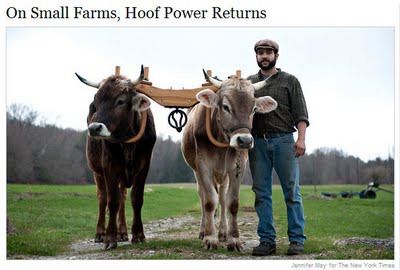
On a sunny Sunday just before the vernal equinox, Rich Ciotola set out to clear a pasture strewn with fallen wood. The just-thawed field was spongy, with grass sprouting under tangled branches. Late March and early April are farm-prep time here in the Berkshires, time to gear up for the growing season. But while many farms were oiling and gassing up tractors, Mr. Ciotola was setting out to prepare a pasture using a tool so old it seems almost revolutionary: a team of oxen.

Standing just inside the paddock at Moon in the Pond Farm, where he works, he put a rope around Lucas and Larson, his pair of Brown Swiss steer. He led them to the 20-pound maple yoke he had bought secondhand from another ox farmer, hoisted it over their necks and led them trundling through the fence so they could begin hauling fallen logs.

Mr. Ciotola, 32, is one of a number of small farmers who are turning — or rather returning — to animal labor to help with farming. Before the humble ox was relegated to the role of historical re-enactor, driven by men in period garb for child-friendly festivals like pioneer days, it was a central beast of burden. After the Civil War, many farms switched from oxen to horses. Although Amish and Mennonite communities continue to use horses, by World War II most draft animals had been supplanted by machines that allowed for ever-faster production on bigger fields.

Now, as diesel prices skyrocket, some farmers who have rejected many of the past century’s advances in agriculture have found a renewed logic in draft power. Partisans argue that animals can be cheaper to board and feed than any tractor. They also run on the ultimate renewable resource: grass.

“Ox don’t need spare parts, and they don’t run on fossil fuels,” Mr. Ciotola said.

Animals are literally lighter on the land than machines.

“A tractor would have left ruts a foot deep in this road,” Mr. Ciotola noted.

In contrast, oxen or horses aerate the soil with their hooves as they go, preserving its fertile microbial layers. And as an added benefit, animals leave behind free fertilizer.

David Fisher, whose Natural Roots Community Supported Agriculture program in Conway, Mass., sells vegetables grown exclusively with horsepower, said he is getting record numbers of applicants for his apprentice program. “There’s an incredible hunger for this kind of education,” he said.

Mr. Fisher discovered farming with horses more than a decade ago as an intern on a farm in Blue Hill, Me. It stuck.

“Using animals is just really appealing to the senses,” he said, adding that he found it philosophically appealing as well. “There’s a deep environmental crisis right now, and live power is also about creating an alternative to petroleum. Grass is a solar powered resource — and you don’t need manufacturing plants or an engineering degree to make a horse go.”

Drew Conroy, a professor of applied animal science at the University of New Hampshire, Durham, who is known in draft-power circles as “the ox guru,” notes that horses and even mules are seeing a comeback. Each animal has its niche.

“Ox are cheap and easy to train but they’re essentially bovine, which is to say, smart but slow,” he said. Horses are faster, more spirited, trickier to train and more expensive to buy and to keep. Professor Conroy notes that mules are better suited to Southern weather. “In the heat, an ox will just stop,” he said.

Even their most ardent supporters concede that draft animals are likely to remain minor features of the rural landscape. For starters, they are cost effective only on small farms. They are also time intensive, performing well only when they can be worked every day, and becoming temperamental when neglected.

On Mr. Ciotola’s first day out with his oxen, he had to struggle with the fact that the long winter had left them rusty. At one point they pulled over and came to a full stop in the bushes. He walked in front of them and tapped them gently.

“They’ve been cooped up all winter, so they get restless,” he said. Indeed, getting Lucas and Larson to go is a much more involved process than turning a key, and even at top speed they are far slower than a tractor. They plod, and Mr. Ciotola must plod along with them.

“You still have to walk nine miles for every planted acre,” said Dick Roosenberg, the founder of Tillers International, a 430-acre farm learning center in Scotts, Mich. A former Peace Corps volunteer, Mr. Roosenberg helped farmers who practiced hand cultivation in third world countries learn about oxen. Eventually, he also taught ox techniques to interpreters at historic communities like Plimouth Plantation.

But now Mr. Roosenberg’s plowing workshops fill with a new demographic: farmers from Wisconsin, Minnesota and even Alaska who hope to use animal power in their fields. Last year, about 320 signed up.

“It’s suddenly not just historic replication, it’s reinvention,” he said. “A new generation wants to do this again, now.”

Oxen are also cheap, at least compared to a tractor, and can work for 10 to 14 years. Since the dairy industry relies on keeping cows pregnant so they lactate, millions of baby bulls are born each year. A pair of calves start at $150 and range up to $1,500, depending on their breed and how much training they have.

Some dairies even give their young males away. Mr. Ciotola got Lucas and Larson, now 2 ½, as wobbly-kneed babies from a nearby raw-milk dairy, bartering for them with his own labor. “I just had to buy or make the yokes and cart,” he said.

Farmers who want to learn the old art of draft power sometimes find their education in odd places. Dominic Palumbo, Moon in the Pond’s owner and chief farmer, learned to plow with an oxen team by way of an intern from Hancock Shaker Village in Pittsfield, Mass., which replicates an 18th-century Shaker community. Mr. Ciotola first learned to work his team from Mr. Palumbo, then later refined his skills by studying a DVD called “Training Oxen,” made in 2003 by Dr. Conroy.
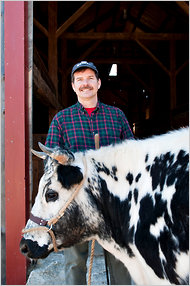
Personal Note: Drew Conroy is the auther of the wonderful oxen training book that DH’s Ma got me for Christmas this year and I love it, such good solid training advice, my only wish is that it had more on how to work with one animal instead of always thinking that you will have a team! I will have to look for the video and put it on my wish list for this coming Christmas!

The film is something of a cult classic in the draft-power community, and in sections covering topics from “the yoke” to “stall etiquette,” the movie pictures Dr. Conroy and his partner, Tim Huppe, working with New Hampshire farmers who raise oxen from their cute baby phases through their slightly belligerent adolescence. It also features each of Mr. Huppe’s four daughters leading her own team around the farm.

Interest in ox-farming became so strong that in 2005 Dr. Conroy and Mr. Huppe began hosting three-day workshops at Sanborn Mills Farm in Loudon, N.H.. At first they were surprised to find themselves emerging as minor celebrities on the draft-power circuit. After all, they had learned ox-pulling as teenagers in 4-H clubs at a time when the activity was mostly seen in shows. “It used to be kind of a cultural thing, a county fair thing,” Dr. Conroy said.

But Mr. Huppe, who sells yokes, oxbows, carts, goads and other gear at his store, BerryBrook Ox Supply, in Farmington, N.H., said his clientele is changing.

“It used to be 15 percent small farmers,” he said. “Now the farmers are more like 60 percent.” About his workshops, Mr. Huppe said, “I feel like the Johnny Appleseed of oxen.”

As draft power spreads, a 7,000-year-old technology is being looked at in different ways.. Some young farmers are developing a hybrid practice, using oxen to supplement, rather than replace, tractors. Some use them just to log and plow, while others have their teams haul machines with engines. Even this can be energy efficient.

“If you use animals to pull a motorized hay-baler,” Mr. Roosenberg said, “you can bale hay pretty fast with about one-third the gas.”

Mr. Ciotola, who does not yet own his own land but who makes his living doing jobs at Moon in the Pond and other Berkshire farms, does have a lightweight tractor, a 1949 Farmall Cub that is particularly suited to small acreages. Some of its accessories — the manure spreader, stone rake and disc harrow — can also be fitted to the ox-drawn forecart he bought from Mr. Huppe’s store.

As the spring morning passed, he continued breaking his team into their third season, walking alongside Lucas’s left side, talking softly. About three hours in, after Lucas pulled into the bushes, Mr. Ciotola turned to head out for one more load, and Lucas pulled back toward the paddock. Mr. Ciotola decided to let him go.

“Lucas is always the troublemaker,” he noted, patting the blond steer. “He’s been restless all winter, but then he gets stubborn.”

For Mr. Ciotola, the most challenging aspect of working with his oxen is finding the time it takes to break them in.

“The best pairs need to get worked every day, and that’s hard for me because I have to do other work during the winters,” he said.

Even though Lucas and Larson now stand 5 feet tall and weigh 1,500 pounds each, they are not yet fully grown. Over the next two years, they will each gain 500 pounds and grow two feet. At that point, they will easily be able to pull 4,000 pounds. Mr. Ciotola wants to have them in prime shape for logging, plowing and haying.

After this season’s first expedition, they stood calmly in the dung-scented paddock, rolling their eyes and flicking their tails as Mr. Ciotola brushed them. Larson ambled off to eat some hay.

“Even when it’s tough with them, it’s better than spending a day with a tractor,” he said.

Then again, there was that time when he nearly took a horn to the groin.

“A tractor doesn’t do that either,” he said.

Other then the personal note, all credit goes to the New York Times! If you are on high speed, they have some video’s to go with. Its great to read that up to 60 percent of the folks interested now are small farmers! Now If it would ever stop raining, I really need to get out and put that baby girl of mine through her paces!

http://www.nytimes.com/2011/05/04/dining/04oxen.html?ref=style

Posted in oxen | 2 Comments

Gardens-Water- A peek into what happens when….

suddenly your water supply is limited, in one of the big cities by me, they have declared that large area is on full water restrictions, and you should here the folks having fits, no filling of swimming pools, or hottubs, they have to truck the water in if they want them filled, no washing of cars or trucks..  but NONE are being more vocal then the local gardeners.

I heard one on the local radio saying and I qoute.

  • I won’t be able to plant any new plants this spring because I can’t use any outside water
  • How will I water my current plants without being able to use extra water
  • I won’t be able to do my gardening, which in turn means I would not be able to grow my own food this summer.

Now, I would like to point out that this person did say she had a house and yard, the city, is offering one rain barrel for 50 dollars per house for this area, which is not a bad price compared to what the stores like to charge for a new barrel.

The average annual rainfall in our area is 940 millimetres (37 in), and the average house is around 2200 sqaure feet, so I am going to say on average 1000 square feet of roof, so that means about a 100 meters x .94 or 94 cubic meters of rain per roof, which equals about 94 tons of rain water that can be collected off your roof.

Add to which we have about 35 weeks of rain season, with 37 inchs on average, and on average most garden plants need at least a inch of rain per week to thrive, but of course mother nature does not deliver that rain at a inch a week but we are certainly able to collect and store it when it does come down.

So lets go back to this master gardener, why can’t she plant new plants, I am putting out new plants in between the rain, I have not had to water in anything, the rain has done it for me, and most are already up and going strong, given the spring we have had in regards to rain, pretty much everything is popping up green and strong.

Won’t be able to water her current plants, I am assuming that these are older plants that should? have had time to grow a good root system and that she can use mulch to help keep the ground from drying out, so the only real reason that I can think of that she believe’s her garden will die from lack of water is that she has overplanted the area, or choosen the wrong kinds of plants for our area.

Now getting to the garden part, if she is doing small square foot gardens, then with rain barrels and water collecting, there is no reason that she can’t keep them water, perhaps it would be fair to say that it will take her longer chore wise to hand water her beds, then with a soaker hose, if she is gardening in a garden plot, then she really has no reason to believe this, “you the gardener” has the ability to space your plants so that they can grow without much extra water given, other then spot watering when starting, and evening watering as needed in the main heat of the summer, again both needs being able to be meet with your own collecting of water.

What I found that bothered me the most was putting together the thought of a hard core gardener with someone that had not go into the green movement enough to have given any thought or planning on collecting water.. but I guess I needed to give my own head a shake.. why should some who choose’s to garden, point in fact also need to be someone who try’s to reduce their foot print? They don’t in fact have to go together..

So here is my final thought, if you are going to garden, please consider looking at what you use and need to have to garden, and consider spending a little time thinking about what you can do in order to be self-contained on meeting those needs.

Posted in gardens | Tagged | 5 Comments

Bumper Crop of Baby Elderberries Bushes

When we moved to our little farm, one of the first things we did when spring arrived was start looking at our local bushes in the hopes that we would have lots of wild food, what we had the most of was Black Elderberry, having a huge bush by our big old back barn.

Since then, we have taken many a small elderberry baby out of the back pasture and up to the house or soft fruit bush lines, by the house we have five bushes, and this spring between three of them were all theres little starts that I thought looked like Elderberries leaves but typically, we get a shoot off the main bush and then we dig it out and move it, sometimes it dies down for the season but always the next spring, its back and in full growth, I had heard that it was VERY hard to grow elderberry from seed, and yet I do think that is what has happened. I have been watching them grow bigger by the day and today picked one and counted off its little ridges, and I am now postive that this little 3 or 4 inch high plants are in fact elderberries from seed.., I would appear to have between 30 to 40 of them in the bed overall.

This makes me very excited, I have a area that I really wanted to put into fruit bushes, and these elderberries will do the trick very nicely, planted six feet apart, they will grow up quickly to make a very good hedge row for that side of the garden/fruit growing area.

As I had looked at what the costs would be to order elderberries and it looks like they would be between 12.99 to 19.99 each, which I knew I would not be paying for considering that I can find them growing wild in the ditch locally, but with the price of gas, I didn’t want to be driving the back roads looking to much this year, this solves all those in one fell swoop.

I will update on how the transplanting goes and will for sure take follow up photos to show how they are doing in the future.

So do you have elderberries on your property? If so what do you make with them? and have you ever had them grow from seed? or do you normally take cuttings or root stock only? Does anyone know if they grow true from seed or if they can be variable?

Posted in gardens | Tagged , , | 17 Comments

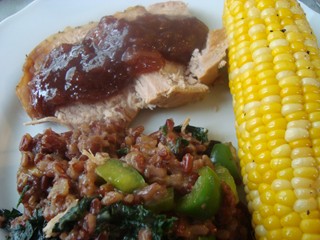
Supper Menu-Pork Roast with Rhubarb Relish an more

What are you having for dinner tonight?

We are having Pork Roast, with Fresh Made Rhubarb Relish,  Corn on the Cob, Red Rice, with Stringing Nettle, Green Peppers with Mozza Cheese Melted In.

Fresh Made Rhubarb Relish Recipe

  • 1 cup fresh Rhubarb, washed, cut into pieces *Do not use Rhubarb leaves, just the stalk.
  • 1 onion, peeled and Diced
  • 1/2 cup of Brown Sugar
  • 1/4 cup white wine vinager (or plain vinager)
  • Pinch of salt, Cinnamon, All-spice, cloves.

Combine in a steel pot and simmer till thick, serve on the side for your pork Roast, I make a canned version of this that is just lovely but fresh can’t be beat!

Posted in Food Production and Recipes | 14 Comments

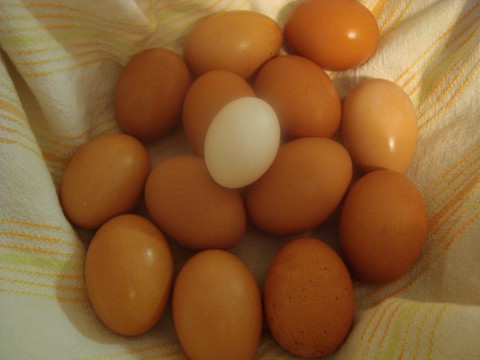
Perserving the spring glut of eggs

Ah Spring, a time of rain, seedlings, hope for the garden and the flush of the first green pasture, and the never ending supply of fresh eggs.

I love using those eggs, I enjoy dippy eggs with dill on them, I like them hard boiled and used in different dishes or just plain with a touch of salt on them, I like egg salad sandwhichs and I adore potato salad and I can’t imagine it without eggs, I use eggs in my breads, cakes, cookies, muffins and more.

Still there are more eggs, and I know that at some point in the dark of winter, that the hens will slow down and I will be wish and some days dreaming of them coming in heavy during those cold dark winter days when we have less then six hours of daylight.

One of the ways I save my eggs is to crack them in a bowl and beat them till well mixed and freeze them, I add a pinch of salt if I am planning on using them for egg use, or a pinch of sugar if they are going to be used in baking, then I pour them into ice cube trays and freeze them solid, one cube equals one egg, I then take them out and put them into double bagged freezer bags, when you want to use them, just take out the amount of cubes you need and put them in a bowl to thaw out in the fridge and then use as normal.

The second way to save them for later use is to dry them, you again scramble and then cook them, and then into your dryer or oven at a very low setting, dry and then if you want you can leave them as is or you can grind them in a blender to a powder for later use, one tsp of dried powder equals one large egg, to use, mix with water and allow to sit for a bit and then use as required. The ones shown above are dry but not powdered yet.

The third way I put eggs up is to pickle them, some folks like the taste of pickled eggs and others do not, your call on this one but don’t just do regular pickled eggs, consider making them spiced pickled eggs or go wild and make purple pickled egg using pickled beet juice, and they will be the most amazing color when they are ready! Shown below, Purple Pickled egg on a bed of green spinach, drizzle a little dressing on and just yum!

So how do you save eggs for later use? This is a Homestead Barn Hop Blog post.

Posted in Food Production and Recipes, Food Storage | 2 Comments

Please vote!

For my fellow Canadian’s, please take the time to go out and vote today in our federal elections.  I feel strongly that everyone should and hopefully does have their own views,  based ideally on reading what the different parties “say” they will do, raither then just on what you have heard on the main media, if you can take a little time to learn, that’s great, but to be honest, if you just “know” which party it is thats yours.. so be it, just get out and vote today!

Sending out a HUGE thank you to all those hardworking folks that will be running the voting booths! Thank you for all you do!

Update: According to the radio this morning, 61% of the allowed voters got out yesterday! so a big thank you for everyone that took the time to get out and voted! There was a few surprises to wake up to this morning in regards to how our new goverment looks, now we see over the next months and years what it will mean for our country.

Posted in Life moves on daily | 3 Comments

New “old” cookbooks

Busy weekend, On friday evening we were fixing fence, saturday we headed out for a little work bee to make a hugelbeet at a friends place and then to have a little potluck afterwards, and on sunday, my step-father was in for meetings about an hour or so away at the big city and so early morning was chores and then off to the city, went to a veggie feast(not so good really) to the local farmer’s market, it was excellent, but the prices were ahhhh!!! and then to the biggest garden center, amazing selection of fruit tree’s, but was looking for a certain kind of seed potato, and it was a no go. Then off to chapters for a book for step-dad’s flight home, and then back home, chores and the evening spent in getting out the things going to the county’s spring cleanup.

However a care package came from my momma, and in it was four new to me but old cookbooks, on is a Nutrition Bonus Cook book from Rogers Flour, Fine Roses Cookbook on Bread and Pastry Etc, for Five Rose Flour, Time-Honoured recipes of the Canadian west from Nabob foods, all look great, and can’t wait to try a few things but then comes the gold mine.. Fat-Back and Molasses, a collection of favourite old recipes from Newfoundland and Labrador.

No, I have not made any of these yet but I so am going to try them..

Dumpling

  • 1 lb of flour
  • 1 and 1/2 cup sugar
  • 1/2  lbs of currents
  • 1/2 lbs raisons
  • 2 tsp B.S.
  • 2 tbsp of marmalade
  • 1 lbs of chopped suet
  • 2 tsp cinnamon, ginger, mixed spice

Mix all ingredients with enough milk so that the mixture is rather dry and not to moist, wet cloth in boiling water, then flour cloth. Put in mixture, tie cloth allowing for swelling. Bring Water to a boil, place a plate in bottom of pot, put in dumpling and boil for 4 hours, keep it covered with boiling water. by Mrs. Eli Foote, burin NFLD,

no details given on how to eat this dumpling.. but I have never read a dumpling recipe like it?

Old Fashioned Pork Cake

  • 1 lbs mince salt pork
  • 1 cup of Molassies
  • 2 cups sugar
  • 1 oz nutmeg
  • 2 oz cinnamon
  • 1 lb of raisins
  • 1 pint of boiling water
  • 2 tsp soda

Pour boiling water over salt pork, add raisons, nutmeg and cinnamon, put soda in molasses, add the flour, bake in a moderate oven for 2 hours.  from Mrs. Osborne, Little Bay East.

Salt pork bread, Salt Pork Buns, Salt Pork cakes.. very intersting.. there is at least four recipes of salt pork bread, the pork is put directly into the dough and then baked right in, there is one comment given that these were then given to the men for the boats and for the children for school as it was a made sandwhich, hmmmm.

Blackberry Bang Belly

  • Bread
  • Cinnamon
  • Spices
  • Baking Soda
  • Flour
  • Salt Pork
  • Molasses
  • Cloves.

Soak bread, Cut pork in very small squares, Add Pork, molasses, spices, small amount of soda and blackberries to soaked bread. Also add enough flour, about one cup to make mixture not as soft. Drain water from bread before adding other ingredients, use amount of bread as needed and molasses to taste.

The above recipe was enjoyed by old and young alike in early summer when the blackberries grew in profusion, it was baked in a long rectangular pan, when cold, cut in slices like a cake.. Joan Andrews, George’s Brook, NFLD

Don’t just love it, there is no amount given on this recipe! just what is used! I don’t know about this one.. it strikes as a odd one, it will either turn out to really good or very much a aquired local taste.

Can’t wait to try out some of the different Salt Pork recipes along with others. If anyone gives these a try, please let me know what you think of them?

Posted in Food Production and Recipes | Tagged | 7 Comments

Wild Winds

Well, yesterday the power went out, and at first the local radio said a few thousand were without power, then a couple hours later it was ten thousand and this morning at 5:30 it was a hundred thousand were without power.

So first on the farm front, the wind really blew, so far, we know that part of the roof got taken off the little red shed, different parts of sheet metal siding are gone from my big barn, and some were found pushing against my sheep fencing. It tipped my big rabbit hutches thankfully at least two of my tie downs held long enough for me to get out in the wind and get it tied back down on all four area’s, it broke one of my big 6 foot high by 20 feet long steel/chainlink panels which meant a sheep breakout, and we have to fix some fence post that got moved around like toothpicks, lots of down branches both big and small but the biggest AHHH was that it flipped my small greenhouse and dozens and dozens of my hertage seedlings were destroyed (attach a whining and pissed voice to that comment), thankfully its early enough to start them all again but I lost alot of money in regards to those seeds and valuble time on restarting the longer length early start plants.

Now normally when we lose power, we just hunker down and hang out on the farm and get on with life, but I keep hearing or reading about things on the net about how other folks react, so I asked DH if we could go to town just to “see” and there is what I learned, folks did’nt remember that no lights mean its a 4 way stop and there was a really bad crash at one of the most busy corners of the town. That folks will pull into dark gas stations and look inside and knock on windows “just in case” A ton of folks were on the road, something that seemed very odd to me as I normally stay home, not go out when we have bad weather. Only the metro and Canadian Tire were open, taking cash only. The Metro was offering no hot or cold/frozen products but you could buy from the rest of the store, and they had been told not to expect power to at least saturday night.

The parking lots was full of those folks buying bread and water?? HUH??

So here is what I learned from my blackout

  • We turned the heat off at the first of April, so no big there.
  • I am grateful once again for the second deep well on a hand pump, no power required
  • I am grateful that we got all the rain barrels set up and they were full
  • So glad I know where all the gear is, and life moves on
  • When there is no hot shower- ah the joy of a hot cup of coffee or tea in the cool mornings can’t be beat.

So folks, did you get pounded by this very nasty storm that ripped though both the states and parts of canada? Let me know if you had any damage in the gardens?

Posted in farm | 4 Comments

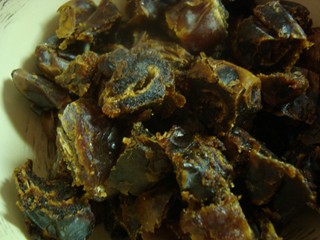
Dried Dates-Don’t overlook this very cheap fruit!

With the ever increasing price of fresh fruits and every other kinds as well, don’t forget to look at Dates and consider adding in a good supply of dried dates, they keep very well if keep cool/dry, I like to store mine in a jar and removed the air and so far I have not lost any that way.

I have been saying to my DH for the past five years at least, I don’t understand why there are not a more popular fruit, sweet, tasty, and so healthy for you, full of vit, minerals and fiber, it even makes it into the top 150 healthiest foods on earth book by Ph. D Jonny Bowden.

Here’s just a few of the perks of Dates, They have been called Nature’s Candy and if you want to cut down use of sugar in recipes, replacing with some dates will hide the fact beautifully. Dates are not low cal foods, a large pitted date has 66 calorie, but o the health part, it has a perfect ratio of calcium/magnesium at one to one, 1 and half gram of fiber and more then 160 mg of heart healthy potassium, there is more then a trace amounts of another half dozen vit/minerals.

Looking for Antiodidents content, well of the berries, Blackberries won the crown with a whooping 5500 TE Score, Dates took the fruits with a score of 6600. So if you want to be able to put away some heavy duty calories in a very small space that can be eaten as is (no heating or cooking required) can be used in many ways once you add in heat/water.

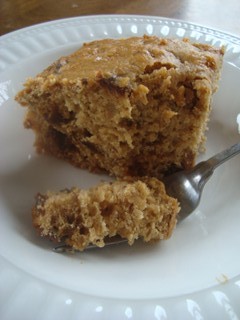
Basic Date Cake FG style

Chop up about a cup of loosely packed Dates into peices, place in a bowl and just cover them with freshly boiled water (make yourself a cup a tea at the same time) then walk away, drink your tea and let the dates sit in the hot water for at least ten min.

This for me is a one bowl cake, so in goes the dates and water, a pinch of salt, two glugs of oil so about 1/4 cup, three big eggs (extra large chicken or two duck), beat togther with dates and water, I like to add 1/2 tsp of all-spice, sometimes ginger, sometimes I will even cut up dried ginger and add it to the dates to soak. Some folks like to add walnuts or any kind of chopped nuts if you do up to a cup, I often don’t.

Two half cups of flour, and a heaping tbsp of baking powder, just stirred like you would for a muffin, and into a 8 by 8 cake pan if you want it really nice and high, but I used a slightly bigger baking dish, bake at 350 for around 40 min or until a knife comes out mostly clean, the dates can leave on the knife but there should be no dough wet.

This is a dense, moist o so flavorful filled cake, the batter could be used in muffin tins or a loaf pan, your choice on how to serve it.  It keeps well for a number of days and freeses like a dream.

So do you use dates in your baking? What is your favorite recipe? I have been known to throw dates into my lamb stews, where with long slow cooking times they just melt into the stew and a wonderful depth to the stew itself.

Posted in Food Production and Recipes, frugal | Tagged , , | 4 Comments

Red Current Jelly

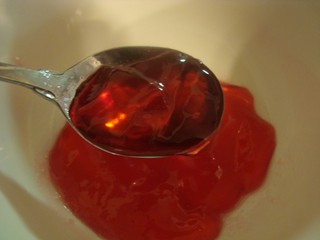
What do you use your Red Currents for? Do you make Jelly, or do you make Juice? or how about Wine? Mix them in with other fruits to add a boost of flavor? This type of jelly is such a pretty color.

I was digging around in the freezer last night, and came up with a bag of rhubarb that was made into a tiny pie (with top only), a bag of wine pear butter for DH’s lunch snack today and there while digging was a small bag of red current, they had been cleaned, now when this happens its typically because the fruit is ready, and I’m really out of time, as I typically make the fruit into the juice, and then freeze flat and stack them until I am ready to make whatever later in the fall/winter.

So last night made them up into Jelly, must have been the last pick because it was a uneven amount, coming in at 2 and half cups of berries, hmm, dug out 1/2 cup of green gooseberries, just covered them with water and boiled and mashed them, then strained though cheesecloth, measured it out 2 and 1/4 cup of juice, matched it with sugar, and 2 tbsp of Lemon Juice and brought it to a boil. The gooseberries provide the pecton for a nice soft jelly and into hot clean jars, as I intend to use these two jar’s up right away, I open kettle canned them, let them seal, cool and into the fridge, when I got up this morning, half a jar was already gone to toast with hubby, and I have to admit that I did the same, I had made a lovely very dense loaf of buckwheat bread on the weekend and that sweet heavy toasted cut of bread with a touch of real butter went so well with this fresh not to sweet but tangy jelly.

Do you have a favorite current recipe? What is your favorite was to serve it?

Posted in Food Production and Recipes, gardens | Tagged , , , | 6 Comments