Break your fast..

Or as we call it now, Breakfast, does it bring to mind, eggs, toast, porridge, or how about waffles or pancakes? Some lovely fresh fruit, with fluffy biscuits with sausage?

What about soup? Do any of you ever have soup for breakfast? I don’t ever remember my mom serving soup for breakfast, then we moved north, and I was invited to breakfast at a local’s and was served soup, it was tasty and very healthy and I enjoyed it alot and when I got home I wondered, why have I never done this before?

Then I was on a international flight and we were served fresh hot soup with our breakfasts and once again, it was perfect, most folks drink hot coffee, or tea which is fine, but why not consider a bowl of fresh hot soup for breakfast. You can make a light broth soup, and drink it from the mug, or if you are going to have a heavy busy day, you can go for a hearty soup. This was our breakfast for saturday morning, leftover roast beef, hashbrowns, fresh greens and mushrooms in a rich broth.

Considering that I will eat what is considered breakfast foods for lunch of dinner, pancakes, porridge, french toast and omlets as examples.. why not switch something that is considered a dinner meal and try it for breakfast!

So do any of you like soup for breakfast? If so, what is your favorite kind?

Posted in food | 1 Comment

Way to quiet…

Lost my phone line for a solid two days and off most of the time for another two days, that means no phone, no internet, no blogging, and no google.. Let me tell you, I am more prepared for power loss, then I am  for the phone line to be gone!

In a way it was very good for working on the farm, on the other hand, I truly felt like I had lost part of my daily routine and I didn’t like it at all. That is the strange thing about writing on a blog or following other blogs, when its not there- you miss them.

Saturday, I got on, and thought the issue behind me, so got my post up and then lost it solid till late tonight, so mother’s day came and went, and I didn’t get to talk to my momma, that was such a odd feeling.

Dh took over the cooking for the day, and like any good farmgal, my mother’s day presents was 3 new blueberry bushes, and some fancy purple/white lilies, along with some very different heritage tomato and pepper plants, along with new garden shoes.

The rest of the day was spent putting up barb wire, which seemed perfect, half the day out plant shopping, a lovingly prepared meal and barb wire fencing.

So what did you do for mother’s day?

Posted in Life moves on daily | 2 Comments

New 140 foot Elderberry Hedge row on the farm.

So we spent a number of hours moving those baby Elderberry’s out of the bed they were in, and we had enough to do more then just one back row of them in hedge space, we have enough to do up the whole side of a garden area as well.

The first thing we learned is that they were NOT from seeds afterall, that every single one of them were in fact connected to one of the adult elder’s by thin little roots (you can see we carefully dug out the new rooting and then cut off the root leaving about 4 inches), they had really travels a good distance as they were in among the lily’s and cedars, not around the adult elder’s themselves.

Now according to the ontario planting guide, for a max production, you should give them ten feet between, but I want a hedge row effect, so I went 6 feet apart instead, I have tried both spacings and to be honest with I don’t see much difference in how they produce, I will admit that with the six foot spacing you can’t walk all the way around the bush, they certainly do meet in the middle but o do they produce like mad when they are that close.

Now, I have read this on other sites and I am going to back them, Elder’s don’t like to dry out at all! between plantings, I highly recommend digging out only what you are moving one at a time so that they get as little chance as possable to dry out before going in to their new home, they tend to wilt, and look very sad, don’t worry they will perk up, or they will die right off, but don’t panic, I have had this happen a number of times, every single time, the roots themselves will shortly send up new starts.

Now I am only speaking for my wild transplanted ElderBerry Bushes, but these guys grow like mad, they can easily grow ten feet in a single season in my climate and soil, they will produce to the point that they will break their own limbs with the weight of the fruit if left alone, I will do a post later in the season to show you how I select how to take out the elder flowers, along with some recipes on how to use them, so that you can help remove some as needed so this won’t happen.

So far we have moved 40 bushes which equal’s 120 foot row so far. We still have at least another ten to move, but it will be up front in the soft fruit rows up by the hard fruit orchard. In total we now have 140 foot of new Elderberry Hedge planted rows

One of the things I am most looking forward to, is having enough Elderflowers to wrap more apples in the dried flowers for keeping in the fall.. the flavor it gives them is heavenly.

Posted in gardens | Tagged , , | 2 Comments

Lemon Dill Salmon Recipe

Take your Salmon Steak, and drizzle a little good oil over it, with a fresh clove of crushed garlic, dried lemon peel, and a heaping tsp of dill and place in a baggy and let it sit at least a couple hours or overnight in the fridge.

The next day in one cast iron pan quickly stirfry

  • One pepper any color, this one was green, that has been cleaned, and cut into stripes
  • One onion, peeled and sliced into stripes
  • 10 mushrooms into large slices
  • Heaping handfulls of fresh greens
  • Drizzle of oil to start them off, with a finish of touch of salt and lemon juice.

In a second small pan, heat at med heat, and put a little oil and place your salmon in, cook about 2 to 3 min per side, and then give it a fresh sprinckle of dill.

If you wanted this to be a more filling meal, you can of course serve this over mashed Potato’s, Rice or Coucous, or over any kind of cooked pasta.

Posted in Food Production and Recipes | Tagged | Leave a comment

The last lamb due has joined the flock

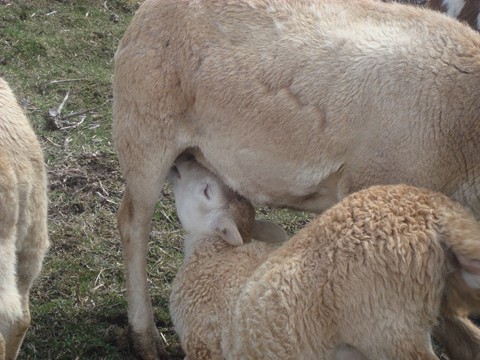
Sheep Update, This past week saw that birth of the last due ewe on the farm, and we were fooled that she was ready a few days before the birth, she sure bagged up early but when the little one came, it was as active and healthy as can be.

Its funny to see her out in the pasture, she looks so tiny compared to the other lambs, the ewes and the older lambs walk, she runs to keep up.

Last year, we had all ewe lambs, this year it was a good mix, with 60 percent ram lambs and 40 percent ewe lambs, only one ewe lamb will be kept back this year, that will be the lovely brown/white girl already named Frudge or as we already call her Frudgelit, now if only her baaa didn’t sound like a deep foghorn, I would think her perfect.

We had some challanges in the barn this year, one stillborn, who I believe died at least a number of days before being born, one loss within 24 hours, and then the true strange one, a perfectly healthy almost two month old lamb, that jumped off the bale the wrong way and broke its neck, we had just seem them jumping around and play not 30 min before, and I had commented, I don’t like that the lambs are climbing the big huge bales of hay, do you think that is safe, and the answer is NO.

We had one bottle feed lamb this year, and one bum lamb, asking yourself the difference, the bum lamb was rejected but fully able to drink off a ewe, and more then willing to do, but mom didn’t want him, but after weeks of taking him to the barn, mom gave up and he moved back out to the barn, he is now 3/4 the size already of his momma.

The bottle lamb are just that, they won’t nurse on momma, they are on the bottle, and become house lambs until old enough to head out to the barn when they are big enough.

Having said that in total we have a dozen lovely lambs romping around the pastures, grazing side by side with their momma’s

Next: gardens, Yardwork, Fencing and I have a number of hens of the feathered kind sitting on nest of eggs, so with luck we will have chicks and ducklings gracing the farm soon enough.

So for those that have sheep, how did your lambing going this spring? Are you done? Are you just starting? Half way there? Do you milk any of the mother sheep for your own use?

Posted in turkeys | Tagged | 3 Comments

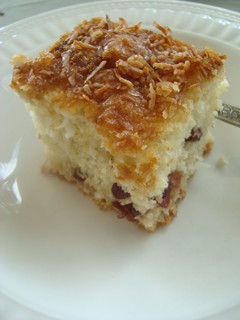
Cranberry Coconut Cake Recipe

Give this lovely flavorful but heavier cake a try, its meant to be a good snack for when you come in from working outside and need something to fill you up a bit and tied you over till the real meal comes.

  • 1/4 cup of oil
  • 1/2 cup of Sugar
  • 2 eggs
  • 1 cup of milk
  • 2 cups of flour
  • 1 tbsp of Baking Powder
  • a pinch of salt
  • 1 cup of dried cranberries (or any other dried fruit)
  • 1/2 cup of Coconut

Mix your oil or Butter/Margine together with your sugar, then add your eggs and beat together, then add milk, then all the dried, mix together, its a fairly thick batter, and into a 8 by 8 glass pan.

Then take brown sugar and lightly sprinkle it on top of the cake batter, till you can’t see it anymore, then take Coconut and repeat, covering the brown sugar, then Bake in a 350 oven for about 35-40 min or until a knife comes out clean.

Serve with Tea or goes wonderful with a big old glass of ice cold milk.

Posted in Food Production and Recipes | Tagged | 6 Comments

Rising Costs of Meat-Are you feeling the effect yet?

Last weekend, my Step-dad was in the “big city” for work and we did a meet up for a visit, lunch and then to give him a ride to the airport, one of our stops from his downtown hotel was the big local farmer’s market, and as I looked at the booths, I was going a little wide eyed. The costs on meat was up, Up and UP. I was surprised to see grass feed lamb, organic but not certified(so eqaul to how I raise my own animals) and the cheapest was 2.99 a pd with the highest cut being 16.99 a pd, to which I say.. good heavens!

Whole Frozen Chickens/Turkeys/Ducks all raised like mine, and running right around 5 dollars a pd, and then there was the beef, o my, the costs of the beef was breathtakingly crazy to me. 

I didn’t see any available rabbit but I know that at our really good local butcher shops a 4 pds dressed out whole rabbit will run between 20 to 25 dollars per.

So this morning on the radio, they were talking Beef on the rise, so here is some of what they said, in Canada, when the border was locked down, the price on beef dropped as low as the seller getting 10 cents per pds in 2002 or 2003.

Lets jump forward on to some reason why we are seeing such high prices and why I don’t think that the price will be going down any time soon.

  •  currently getting 65 cents per pd in my local area, which is up to a full 55 cent per pds increase for the farmers.
  • Less farmers, less cows, since 2003-2004, we currently have 1.5 million less cows on farms, that means 1.5 million less calves per year being born.
  • Farmers switching from Cow/Calf to Cash Cropping, Soy and Corn being the main crops being done as the rising prices on these crops mean that more money is to be made.

Interestingly, the farmer said that the bigger stores were in fact taking on some of the higher costs at the meat counter so that they could raise the prices slower, as there are consumer studies that say that if you raise things 3% that the will grumble but still buy but if it jumps 5% or more on a single item, that the rumbles will grow loud enough to make them choose to look for a cheaper cut of meat or a different meat altogether.

Other costs that add to rising prices that they didn’t talk about, but I am sure they figure in as well.

  • Rising feed costs
  • Rising Vet Costs
  • Rising Hydro Costs
  • Rising Gas Prices
  • Rising Costs on All Fencing materials, when we fenced our first pasture four years ago, we paid 180 for that roll of sheep fencing, the second pasture those same rolls cost us 210, the third pasture, the same fencing cost 260, and this year, that same roll is now listed at 300. Of course to be honest, I have never paid full price, I always buy only when our local feed store puts them on sale twice a year typically 25 to 35 percent off.. still that is one huge hike in price!

So let me hear from you? Are you seeing the same increases in your area, your country? Do you eat beef? If so, are you buying less? What are you replacing it with, a different meat? or are you eating less meat? For those with land, are you looking hard at any spare peice of land and working to figure out how to grow your own protein on it? If this is the effect on regular prices, what does this mean for the local prices in regards to “organic beef” which is typically sold at least 30% higher.

Posted in farm, food | Tagged , , , , , , | 11 Comments

Troublesome Flower Bed!

Ok, I admit it, I have a spot that is to be a flower bed that has cost me more time and effort then I would ever want to admit to, when we moved here, the very first bed we made was on the east side of the house, I planted two lovely bushes, that have done very well and then planned on filling the one spot that is about 10 feet by 5 feet with flowers being mainly with those that would come back year after with a bit of spring color in the form of annuals. Sounds like such a simple plan yes?

Huh, I have redone that bed for five years now and it still does not work, I have filled it with bulbs, that the chickens dug out, I have put in grasses that refused to grow? I have done tomato’s that loved it (Maybe I should just give up and make it a garden spot) I have done it into wild flowers, and still between the heat, and the chickens, it never works well or for long.. so this year, I REFUSE to spend any money on replanting it, anything that is going in there has to be free from the farm garden and or the pasture etc.

So here is my new plan, at the back, I am going to put in a row of Red Bee Balm, as they are the tallest, the second row will be Ditch Lily’s or Tiger Lily’s, the third row is going to be wild violets, as they grow freely as a ground cover under my big tree’s and the last front row is being planted into strawberries. All really tough plants that “should” come back year after year and between them fill in every single nock and granny in that bed.

Ok dear readers, what do you think of this plan? Would you add to the list and if so what? Do you have one spot that because of shade, heat or pets/chickens that is a trouble spot in your garden?

Posted in gardens | Tagged , | 4 Comments

Oxen in the main stream media! Awesome

On a sunny Sunday just before the vernal equinox, Rich Ciotola set out to clear a pasture strewn with fallen wood. The just-thawed field was spongy, with grass sprouting under tangled branches. Late March and early April are farm-prep time here in the Berkshires, time to gear up for the growing season. But while many farms were oiling and gassing up tractors, Mr. Ciotola was setting out to prepare a pasture using a tool so old it seems almost revolutionary: a team of oxen.

Standing just inside the paddock at Moon in the Pond Farm, where he works, he put a rope around Lucas and Larson, his pair of Brown Swiss steer. He led them to the 20-pound maple yoke he had bought secondhand from another ox farmer, hoisted it over their necks and led them trundling through the fence so they could begin hauling fallen logs.

Mr. Ciotola, 32, is one of a number of small farmers who are turning — or rather returning — to animal labor to help with farming. Before the humble ox was relegated to the role of historical re-enactor, driven by men in period garb for child-friendly festivals like pioneer days, it was a central beast of burden. After the Civil War, many farms switched from oxen to horses. Although Amish and Mennonite communities continue to use horses, by World War II most draft animals had been supplanted by machines that allowed for ever-faster production on bigger fields.

Now, as diesel prices skyrocket, some farmers who have rejected many of the past century’s advances in agriculture have found a renewed logic in draft power. Partisans argue that animals can be cheaper to board and feed than any tractor. They also run on the ultimate renewable resource: grass.

“Ox don’t need spare parts, and they don’t run on fossil fuels,” Mr. Ciotola said.

Animals are literally lighter on the land than machines.

“A tractor would have left ruts a foot deep in this road,” Mr. Ciotola noted.

In contrast, oxen or horses aerate the soil with their hooves as they go, preserving its fertile microbial layers. And as an added benefit, animals leave behind free fertilizer.

David Fisher, whose Natural Roots Community Supported Agriculture program in Conway, Mass., sells vegetables grown exclusively with horsepower, said he is getting record numbers of applicants for his apprentice program. “There’s an incredible hunger for this kind of education,” he said.

Mr. Fisher discovered farming with horses more than a decade ago as an intern on a farm in Blue Hill, Me. It stuck.

“Using animals is just really appealing to the senses,” he said, adding that he found it philosophically appealing as well. “There’s a deep environmental crisis right now, and live power is also about creating an alternative to petroleum. Grass is a solar powered resource — and you don’t need manufacturing plants or an engineering degree to make a horse go.”

Drew Conroy, a professor of applied animal science at the University of New Hampshire, Durham, who is known in draft-power circles as “the ox guru,” notes that horses and even mules are seeing a comeback. Each animal has its niche.

“Ox are cheap and easy to train but they’re essentially bovine, which is to say, smart but slow,” he said. Horses are faster, more spirited, trickier to train and more expensive to buy and to keep. Professor Conroy notes that mules are better suited to Southern weather. “In the heat, an ox will just stop,” he said.

Even their most ardent supporters concede that draft animals are likely to remain minor features of the rural landscape. For starters, they are cost effective only on small farms. They are also time intensive, performing well only when they can be worked every day, and becoming temperamental when neglected.

On Mr. Ciotola’s first day out with his oxen, he had to struggle with the fact that the long winter had left them rusty. At one point they pulled over and came to a full stop in the bushes. He walked in front of them and tapped them gently.

“They’ve been cooped up all winter, so they get restless,” he said. Indeed, getting Lucas and Larson to go is a much more involved process than turning a key, and even at top speed they are far slower than a tractor. They plod, and Mr. Ciotola must plod along with them.

“You still have to walk nine miles for every planted acre,” said Dick Roosenberg, the founder of Tillers International, a 430-acre farm learning center in Scotts, Mich. A former Peace Corps volunteer, Mr. Roosenberg helped farmers who practiced hand cultivation in third world countries learn about oxen. Eventually, he also taught ox techniques to interpreters at historic communities like Plimouth Plantation.

But now Mr. Roosenberg’s plowing workshops fill with a new demographic: farmers from Wisconsin, Minnesota and even Alaska who hope to use animal power in their fields. Last year, about 320 signed up.

“It’s suddenly not just historic replication, it’s reinvention,” he said. “A new generation wants to do this again, now.”

Oxen are also cheap, at least compared to a tractor, and can work for 10 to 14 years. Since the dairy industry relies on keeping cows pregnant so they lactate, millions of baby bulls are born each year. A pair of calves start at $150 and range up to $1,500, depending on their breed and how much training they have.

Some dairies even give their young males away. Mr. Ciotola got Lucas and Larson, now 2 ½, as wobbly-kneed babies from a nearby raw-milk dairy, bartering for them with his own labor. “I just had to buy or make the yokes and cart,” he said.

Farmers who want to learn the old art of draft power sometimes find their education in odd places. Dominic Palumbo, Moon in the Pond’s owner and chief farmer, learned to plow with an oxen team by way of an intern from Hancock Shaker Village in Pittsfield, Mass., which replicates an 18th-century Shaker community. Mr. Ciotola first learned to work his team from Mr. Palumbo, then later refined his skills by studying a DVD called “Training Oxen,” made in 2003 by Dr. Conroy.

Personal Note: Drew Conroy is the auther of the wonderful oxen training book that DH’s Ma got me for Christmas this year and I love it, such good solid training advice, my only wish is that it had more on how to work with one animal instead of always thinking that you will have a team! I will have to look for the video and put it on my wish list for this coming Christmas!

The film is something of a cult classic in the draft-power community, and in sections covering topics from “the yoke” to “stall etiquette,” the movie pictures Dr. Conroy and his partner, Tim Huppe, working with New Hampshire farmers who raise oxen from their cute baby phases through their slightly belligerent adolescence. It also features each of Mr. Huppe’s four daughters leading her own team around the farm.

Interest in ox-farming became so strong that in 2005 Dr. Conroy and Mr. Huppe began hosting three-day workshops at Sanborn Mills Farm in Loudon, N.H.. At first they were surprised to find themselves emerging as minor celebrities on the draft-power circuit. After all, they had learned ox-pulling as teenagers in 4-H clubs at a time when the activity was mostly seen in shows. “It used to be kind of a cultural thing, a county fair thing,” Dr. Conroy said.

But Mr. Huppe, who sells yokes, oxbows, carts, goads and other gear at his store, BerryBrook Ox Supply, in Farmington, N.H., said his clientele is changing.

“It used to be 15 percent small farmers,” he said. “Now the farmers are more like 60 percent.” About his workshops, Mr. Huppe said, “I feel like the Johnny Appleseed of oxen.”

As draft power spreads, a 7,000-year-old technology is being looked at in different ways.. Some young farmers are developing a hybrid practice, using oxen to supplement, rather than replace, tractors. Some use them just to log and plow, while others have their teams haul machines with engines. Even this can be energy efficient.

“If you use animals to pull a motorized hay-baler,” Mr. Roosenberg said, “you can bale hay pretty fast with about one-third the gas.”

Mr. Ciotola, who does not yet own his own land but who makes his living doing jobs at Moon in the Pond and other Berkshire farms, does have a lightweight tractor, a 1949 Farmall Cub that is particularly suited to small acreages. Some of its accessories — the manure spreader, stone rake and disc harrow — can also be fitted to the ox-drawn forecart he bought from Mr. Huppe’s store.

As the spring morning passed, he continued breaking his team into their third season, walking alongside Lucas’s left side, talking softly. About three hours in, after Lucas pulled into the bushes, Mr. Ciotola turned to head out for one more load, and Lucas pulled back toward the paddock. Mr. Ciotola decided to let him go.

“Lucas is always the troublemaker,” he noted, patting the blond steer. “He’s been restless all winter, but then he gets stubborn.”

For Mr. Ciotola, the most challenging aspect of working with his oxen is finding the time it takes to break them in.

“The best pairs need to get worked every day, and that’s hard for me because I have to do other work during the winters,” he said.

Even though Lucas and Larson now stand 5 feet tall and weigh 1,500 pounds each, they are not yet fully grown. Over the next two years, they will each gain 500 pounds and grow two feet. At that point, they will easily be able to pull 4,000 pounds. Mr. Ciotola wants to have them in prime shape for logging, plowing and haying.

After this season’s first expedition, they stood calmly in the dung-scented paddock, rolling their eyes and flicking their tails as Mr. Ciotola brushed them. Larson ambled off to eat some hay.

“Even when it’s tough with them, it’s better than spending a day with a tractor,” he said.

Then again, there was that time when he nearly took a horn to the groin.

“A tractor doesn’t do that either,” he said.

Other then the personal note, all credit goes to the New York Times! If you are on high speed, they have some video’s to go with. Its great to read that up to 60 percent of the folks interested now are small farmers! Now If it would ever stop raining, I really need to get out and put that baby girl of mine through her paces!

http://www.nytimes.com/2011/05/04/dining/04oxen.html?ref=style

Posted in oxen | 2 Comments

Gardens-Water- A peek into what happens when….

suddenly your water supply is limited, in one of the big cities by me, they have declared that large area is on full water restrictions, and you should here the folks having fits, no filling of swimming pools, or hottubs, they have to truck the water in if they want them filled, no washing of cars or trucks..  but NONE are being more vocal then the local gardeners.

I heard one on the local radio saying and I qoute.

  • I won’t be able to plant any new plants this spring because I can’t use any outside water
  • How will I water my current plants without being able to use extra water
  • I won’t be able to do my gardening, which in turn means I would not be able to grow my own food this summer.

Now, I would like to point out that this person did say she had a house and yard, the city, is offering one rain barrel for 50 dollars per house for this area, which is not a bad price compared to what the stores like to charge for a new barrel.

The average annual rainfall in our area is 940 millimetres (37 in), and the average house is around 2200 sqaure feet, so I am going to say on average 1000 square feet of roof, so that means about a 100 meters x .94 or 94 cubic meters of rain per roof, which equals about 94 tons of rain water that can be collected off your roof.

Add to which we have about 35 weeks of rain season, with 37 inchs on average, and on average most garden plants need at least a inch of rain per week to thrive, but of course mother nature does not deliver that rain at a inch a week but we are certainly able to collect and store it when it does come down.

So lets go back to this master gardener, why can’t she plant new plants, I am putting out new plants in between the rain, I have not had to water in anything, the rain has done it for me, and most are already up and going strong, given the spring we have had in regards to rain, pretty much everything is popping up green and strong.

Won’t be able to water her current plants, I am assuming that these are older plants that should? have had time to grow a good root system and that she can use mulch to help keep the ground from drying out, so the only real reason that I can think of that she believe’s her garden will die from lack of water is that she has overplanted the area, or choosen the wrong kinds of plants for our area.

Now getting to the garden part, if she is doing small square foot gardens, then with rain barrels and water collecting, there is no reason that she can’t keep them water, perhaps it would be fair to say that it will take her longer chore wise to hand water her beds, then with a soaker hose, if she is gardening in a garden plot, then she really has no reason to believe this, “you the gardener” has the ability to space your plants so that they can grow without much extra water given, other then spot watering when starting, and evening watering as needed in the main heat of the summer, again both needs being able to be meet with your own collecting of water.

What I found that bothered me the most was putting together the thought of a hard core gardener with someone that had not go into the green movement enough to have given any thought or planning on collecting water.. but I guess I needed to give my own head a shake.. why should some who choose’s to garden, point in fact also need to be someone who try’s to reduce their foot print? They don’t in fact have to go together..

So here is my final thought, if you are going to garden, please consider looking at what you use and need to have to garden, and consider spending a little time thinking about what you can do in order to be self-contained on meeting those needs.

Posted in gardens | Tagged | 5 Comments