Gardening for your critters

I know that most folks are seeing food prices going up, the size of the box’s going down, and everyone scrambling to figure out ways to cut down their food shopping bills, while still trying to feed themselves and their children a healthy balance of fresh food.

The cost of feed is also going up and depending on where you shop, the bag sizes are going down, one feed store sent a flyer out and it had great prices per bag, until DH pointed out that it was for 25kg bags instead of our typical 40kg bags, then that price was not just not a good deal, it was much higher. The purr-pots and hounds foods are going up as well it seems like almost every month or two months, thankfully at our regular feed store if you buy five or more 40 kg bags you get a 5 dollar’s off.

So how can we help reduce the costs with a little (or lot) of elbow grease.. the answer is in the garden, or if you don’t have a garden, the answer might be in your local farmer’s market or down that farmers lane. When you are buying your fresh goodies at the farmers market, ask them if they have seconds available by the bushal or half bushal, and if so, provided you have time to do the prep work to get them ready, snap them up for your critters.

Now if you have the space to do it, plant extra rows of your basic potato’s, carrots, turnips, beets, and extra rows of greens, talk to your local u-pick apple place, and ask about windfall apples for critter use, at the one by me, you can only take apples off the ground but its 5 dollars a bushel to do so.

The perk of when you are putting up critter food, is that you don’t have peel things the same way, you can store them in your cellar, or put part of your freezer for cooked whole extra’s or you can dry them, takes less space, and works well for the hounds, you just throw some in the bowl, cover with boiling water and let it sit with some mixed oatmeal etc and voila, you have mixed veggies in grual, and the old girls and guys will give you rubs of joy for your effort.

I grow radish’s for seed harvest, they will produce lots, which is great, so you can sprout in winter for fresh greens, when you send out your livestock for butcher make sure you tell them you have hounds and ask for everything back that they could use, or for those that don’t have their own livestock, track down that small local family owned butcher and talk to them about being able to get raw meaty bones, organ meat etc

For those that are milking, having leftover fresh whole raw milk to go to the different critters is wonderul, same with whole farm fresh eggs, they amount of eggs getting away from you, hard boil up a couple dozen and add them chopped up over top a couple fresh cooked potato’s mixed together and even your most picky purr-pot will chow down.

While I fully respect those that are willing to pay 60 to 80 dollars for a bag of their favorite house critter food, but I personally think making a few meals a week from foods that you can grow yourself greatly helps reduce the bills and puts you directly in control of making sure they get healthy, local fresh food.


Posted in Critters | Tagged , , , , , , , , | 3 Comments

Making Hay with the sun does shine..

According to A Jackson in 1001 weird Facts for Canadian Gardeners the largest organic crops grown in Canada is hay, and almost all of it is sold to the US for their organic dairy farms.. huh, who knew?

One of the few books I have found that covers many of the issues of very small hay management is this book

Today has rained, and rained and rained, light rain, hard rain, pelting rain so hard it sounds like hail on our metal roofs, and with this rain goes all hope that the stripe of perfectly ready hay that was hand cut down will turn into good quality hay, its  lots enough value to the rain that when allowed to dry out, it will be good for bedding and not much else.

My little farm is not certified organic but not a single chemical has touched my hay fields since I bought the farm, but I am well aware that the fields next to it do get sprayed, part of the reason, we pulled the fence lines back one lawn mower lane on the outside.

While this is hard work and I would not recommend doing this for any length of time if you are not fit, as it is a workout and half, hand cutting hay, hand raking dried hay into rolls and then if you want making and using your own small sqaure baler is a real choice for those that have a small area to do. We tend to do a quarter acre at a time, we also use the flock of sheep to control the pasture growth in order to have different parts at different growth stages in to order to be able to not have to do a couple acres all at the same time.

On average DH can cut a 1/4 acre in a matter of an hour to an hour an half, depending on how fast he sharpens the blade at the end of each line, you can cut more lines without doing this but you will see the effect when you want to rake/roll it for drying.

The hay is cut in a way that it is spread out and falls in a certain pattern, typically I am the one that checks the hay and then taking a rake, rolls it to help the underside dry, at that point, depending on the use we have planned for it, it can be rolled, tied and hauled to the barn as is.

The second choice is to use the small sqaure hay baler that Small Farm Canada put out directions for (I thought I would find it online to direct you to) but so far I have not been able to.. its not hard to make at all.. Make a box, cut panels on both ends, lay the bale twine across the bottom and out both ends, two in total, stuff box with hay till you can’t get it packed tighter or harder and then lift the twines up and tie them off, pull bale straight up and its done.. its not as neat or tight as a machine bale but its alot better then rolling it if you want to stack them.. personally I find loose hay rolls just as easy to work with and just as easy to lift into the hay loft and then fork down for the critters.

As you can see from above there are whole books on the subject on how to get hay right and how the mix of what you grow will effect the protein of the feed, and therefor different mix’s for different critters, some do better with first cut, some can do either first cut or second cut, makes little difference to them and their condition. The bottom line is that you cut at the right time, and that you get the hay dry so that it won’t mold or lose condition in storage.

While the timing has to be perfect if you are cutting many acres of hay and in that case if you can hire someone to do it, it would be worth it in the long run, but if you are doing smaller area’s and you want to be able to pasture rotate, then cutting by hand is a great skill to have and one that we often forget that for many hundreds of years, that was how it was always done!

This is a homestead hop blog post, do click on the link and see what all the other homestead folks are up to!

Posted in farm | Leave a comment

Good deal but Bad Farm Sale!

Well, I had a ton of things to do today so taking time out for a farm sale was really not a great idea to tell the truth but I had invited a friend and she said yes so even though when I got up in the morning and hummed a bit, off I went..

Lesson #1 learned: The auctioneer makes a HUGE difference in the sale, I normally almost always go to a sale run by a local called Peter, his father-in-law,  (who had the business for years) and the wife,  her brother, grandma and granddaughter and they are fast, they move like lightening at sales, they have a set way the sales run by the layout and you have a good idea of how they do things, anything that is going to be sold per peice is on a table or wagon set out in sets or singles, the rest is box sets, with normally one or two good things folks want in a box of so-so, then you move to the down the line to house stuff, then over the garden and always farm supplies/work supplies is last.. its the same lay-out at every sale, you can count on it.. 

Well between the two older gentleman (very sweet but had to in their 70’s) the fiftyish son who was very unhappy at the prices, they had the sale moving as slow as I have ever seen! Everything was being sold one thing at a time, no group lots, every single book pull out, every single rod sold each, each saw etc etc.. This should have been a 10 to 4 to 5pm sale, I would not be surprised if they are still there at 8 tonight..

So found a few things that I was interested in, huge box of steel bowls for canning/prep-work, a fruit juice steamer in good condition and a box of good qaulity steel pots of different shapes.. but did they start at the kitchen wagon? NO, they started at one of four tool wagons… selling each little box of tool bits one at a time..oh.. my… God!

No way am I spending the whole day on this.. but something had caught my eye, a set of six very large metal U in the farm equipment row.. now I have seen these at the farm store, and they cost 50 each new, so I was interested in them.. but figured at the pace they were going, I would head home, put a few hours of good hard work in and then head back out to catch the tail end of the sale and that farm row.. should have known they would not do it in order..

So got to the sale and its clear that they have(might?) been down the line but its not clear that anyone has claimed the big U bars, so I head over to ask, yes they have tried to sell them, no one would bid on them.. ok, well I want them, go talk to a old guy, leads me to the son (who was grumpy in the morning, is now red faced unhappy), I explain that no one would bid on them, and I would be interested, would he take five dollars (note: I would have paid five each without blinking) but he says.. No, I might consider $ 50, which makes me snort.. 50 for something they could not sell at the time they were up! I don’t frickin thing so.. So, I said, no, he says then tell them to re-sell them and see if you can get better..

So put them in line to be sold.. wait 30 min while they sell ten saws and box’s of fishing gear, one single peice at a time while the very small and tired and worn crowd buys each one at 1 to 3 dollars each.. finally mine come up.. gentleman says, start the bids at $200, I smile and say.. Five dollars for the lot.. he says, anyone (knowing that there is no one) says sold, so in total for something new at the feed store for 250 plus tax, I paid 5 dollars plus tax. Its a great buy, I am thrilled with the buy, but not a good sale overall.

So what am I going to do with my six feet wide, six feet high at the center point so new they still have their tags on them steel U poles.. I’m going to dig them down by about a foot and half into the garden, put them about six feet apart and make myself a 36 foot long, four feet high, 6 foot wide cold frame! As I happened to buy a big roll of greenhouse plastic at a farm sale last year for 8 dollars (no one knew what it was), that means I have a) recyled all the parts, as I will weight it with rocks on the farm, and put together the whole kit for a total of 13 dollars plus tax..

That’s amazing!, I’m thrilled and look forward to doing some late fall plantings under it, photo’s coming when we get it set up..  So what do you think? Did I get a good buy? If you had seen them, would you have thought of that way to use them?

Posted in farm sales | Tagged , , , | 4 Comments

Spaghetti Squash Recipe..

Here is one of my favorite recipes  for Spaghetti Sqaush, hmmm, we are going to do a fresh farm overview on it but it can easily be made with the items from the store or your fully loaded pantry!

Find a nice big Spaghetti sqaush ready in garden (or the store or farmers markets), Slice the sqaush in half, using a big spoon or a mellon baller to clean out the seeds and guts, if you have chickens they will do a clucky dance of joy for this, if not, compost pile or into a veggie soup stock? Then run a light coating of oil on the outside rib and face down into pan covered with tinfoil and into the oven, if you have a good qaulity toaster oven, you can do this with less power then running your big oven, if using the big oven, come up with a couple different things to bake off at the same time. Bake for about 25 to 30 min till fork tender, at 350..

In your cast iron pan, put half a pd of ground lamb (or beef or goat) with one onion finely chopped, at least two or three big cloves of garlic diced up and brown it up, the meat should have no pink, the onion clear, at this time put in 6 to 8 good size tomato’s diced up into small cubes along with lots of diced fresh basil, simmer it briefly..

Take out your sqaush and using very clean dish cloths, gentle and carefully(its hot) flip the half over (if you cook it down, it will be to watery) and scoop your wonderful meaty/tomato goodness into the half, it should fill each shell, top off with big slices of mozzara or any other kinds of melty white cheese with a touch of diced fresh basil on top, into the oven for 3 to 5 min till melted and bubbling..  I tend to serve a half per person, but you could either work with smaller sqaush or self half if you want, but a side each works perfectly..

Side on plate and serve, they take their forks and pull off  stands into the mix while eating it, or you can loose the cheese and cute presention and scoop out the squash, heaping the threads into a big pile on a platter, and cover with your meat/sauce and sprinkle some parm on it..

Posted in Food Production and Recipes | Tagged , , | 2 Comments

Sometimes you just need to recharge your batteries!

Sometimes on a farm that moment when you listen to the frogs or see the fireflys or watch a newborn lamb nursing or see a peeping chick or duckling chasing down a bug, you are filled with a sense of wonder that you get to have all this on the farm..

But sometimes you just need to spend a little time off the farm in the company of fellow lady folks, you get to catch up on how is the family, the gardens, the hubbies, you get to do the little “does your man ever do this?” but when you get the right group of girls together, you have moments.. Moments when you watch a mother nurse her newborn little one with a look of pure contentment on her face, moments when the laughter fills the room, moments when silence fills the room and deep thoughts are expressed afterwards.

As much as I love my DH, and I do, there is something special about time spent in the company of other women, that I believe we need it for balance in our lifes and to be able to refocus, to redirect energy, to just fills that cup up to overflowing with the blessings life brings us if would just stop but a moment and see it.. Thanks for the coffee girls!

Posted in Life moves on daily | 3 Comments

Milking Sheep

I got asked a question by a family member the other day that went along the lines of, I know you milk your sheep but did you have to buy special sheep to do it?

The short answer is, I would if I could! but no..

The long answer is that there are milking breeds of sheep, the main one I have researched being the East Friesian, this breed of sheep are primarily raised for milk, lots of milk, lots of lambs, issues with my area, does not like heat (we have heat in the summer) and requires lots of really good feed and high energy impute to put out that vast amount of milk.. still we do have a few breeders in my province but at this time, they are either keeping back their ewe’s to grow the flock or selling starter flocks are very high prices at the moment, the rams are also getting high prices to be used in cross-breeding into commercal flocks as they are big sheep with a good growth rate on the lambs.

The second breed I have looked at is the British Milking Sheep, I like what I read but can’t find any to even really price out, they came to canada only in 1999, so to say they are rare would be a fair thing..

Katahdin is my milking sheep of choice, I like my hair sheep, they may not give wool but they are a wonderful breed of sheep, they are excellent on pasture, require little in way of extra feed(unless I want to give it to them) have excellent twin rates, natural easy birthing, and strong good mothering.

My first couple years of lambing, I could not help but notice that a few of the girls had just wonderful teat placement and larger teats then the rest of the girls,  I would not want to milk some of the girls, I have done so to get a bit of milk into the mouths of newborns that are having trouble figuring it out etc, and its not fun or something I want to do once a day.

However I have two breeding lines that produce excellent bags and teat size and placement for milking, one line has the perfect temperment for it and one line does not.. the key difference’s being.

  • Line A is naturally a much more trusting line then Line B
  • Line A is not only calmer but better at understanding a routine then Line B
  • Line A willingly get on the stand after a couple days of being lead by the grain pan, and soon will be on it, head in, waiting for you, Line B, has to be lead into the milking room and wants the grain but will dart around the room until finally caught by collar, taken to stand and while you can get them to put the front up, you almost always have to lift the rear before they settle down.
  • Line A is a easy let down, give them their warm bag wash up, do a lamb bop on the bag three times (something you would never do with any other milking girl) and the milk flows, Line B will give you the first glut of milk but really makes you work for the extra
  • Line B has the ability to outproduce Line A..

So what is a farmgal to do.. Did you just say, breed line A an B together and keep back the temperment of Line A but with the increased good points of line B.. cuz if you did.. you are bang on..  I held back one carefully selected ram and did a cross back line breeding and got not one but two lovely ewe’s from the breedings, who have the better temperments but we will see if I get the extra’s when they lamb for the first time this coming year (they had to grow up first) but I am hopeful.

So like all other dairy animals they thrive on gentle but firm care and they love their routine, mine goes like this, I might last, as I want the milk to come to the house as fresh as possable, so call the sheep in that are to be milked, typically at least two, both come in, Milking girls have collars and you snag a collar and snap one to the wall to wait and if trained the other one jumps onto the milking stand and put’s her head though to get to where her milking rations will be..

I do give grain milking rations mixed with a complete sheep chow and typcially a once a week extra like kelp etc, when I am asking the girls to be heavy milkers, I do it for a couple reason’s, asking them to produce milk like they have extra lambs is hard work, but also because it is a reward for being milked.. no milking, no milking ration, on the stand, reward, off the stand, no reward.. if the sheep is even tempered, this works out quickly and easily.  Once on the stand, I like to give the bag a warm wash with a cloth, it cleans the bag, and it feels good to them, then I stripe test each teat into the test cup to make sure the milk looks good, and then its time to rest the head on the flank and get that swish, swish going into my steel bowl, I perfer steel to milk in, as its the best for getting clean in between, in the deep of winter the bowl is so cold that the first hits of milk tend to freeze but it will fill up, once done milking, be kind and put a little bag balm on the teats if its needed, and then give your girls a little pat and let her back out and clipped to the wall and repeat as needed, then let go and open the gate and out of the milking room.

If anyone has had a poo in the room, sweep it up and remove, at least twice a week (if you want to be fussy, daily) you should go down and give a good wash/scrub of the milking stand itself, as they do get it dirty with their feet, wipe or  wash out their feed bin daily as they will get it all covered in spit, I would recommend each sheep has its own bin for its milking ration, they don’t normally swap spit and it might not be needed but it just seems like a clean thing to do.

Let them go back to the main flock for the day as they will be more relaxed and happy that way, at the evening chores, using just a touch of grain, bring them within catching reach and put them into their jug for the night, with their lambs beside them but not able to get them, I swear after the first nights of crying, everyone will settle down into the idea.. Then you milk them for house use in the morning and the lamb or lambs feed during the day, (don’t take any milk at all from a girl that has more then two lambs).

If you know that you want one of your girls for milking, you can see if you can get a different ewe to take one of her twins as their own, so that you can have the extra milk for the house, it does take a bit of work but if you know your ewe’s there will always be a older girl who while giving a few starting head butts will take an extra lamb if introduced right and jugged up with her for couple days to bond, provided the timing of her lambing is right.

You can also wean a strong milking girls lambs when they are old enough and still have months of milking from their mother, only thing is, then you need to milk twice a day and every day, where if you can shift one lamb on a set of twins to a different ewe, you can leave her lamb with her if you need or want to not milk for a day or two for whatever reason and all is well.

On average my milking sheep girls give about a quart jar of milk per milking in the flush, nothing like a milk goat will produce but the sheep milk is so very rich, you don’t use it to drink, it’s used for baking or to make yogurt, or many kinds of cheeses with. You can even make sheep milk icecream..

So if you have sheep out in the pasture, check your girls over carefully and see if you can find that rare but wonderful girl who’s teats are bigger and come down more and take advantage of it and add sheep milk to your kitchen, if you are anything like me, you will be very pleased with the qaulity of the milk you get.

As for me, my milking is winding down, my girls will be or already are heading into breeding season, so its dry up time around here. At least for a little while, I have one expecting ewe who should lamb out in oct, as she breed out of season and is already showing..


Posted in raw milk | Tagged , , | 10 Comments

Thermos Shuttle Chef

Well part two of my ultra frugal plan to be able to cook food during our power outages, as well as a way to cut down on power use in regards to cooking meals. If you didn’t read up about my new little cook stove the Ecozoom, check out that post, as this one goes with to a point.

My Thermos Shuttle Chef cooker has arrived, now this is two specially made steel pots, one that gets heated and the food is brought up to a boil and or is simmered at a slow boil for up to 15 min (which seems the longest time given in any of the recipes) and then you take it off the heat and put it into your outer steel pot and it continues cooking and staying safely hot for up to six hours.

During my reseach into this idea, I had found out that it was very popular in Japan, and was being used as a way to cut energy use and still be able to cook full meals that are served hot, this is backed up by my new cookbook that came with the  gear, while I do have a english version, its been translated from their recipes.. Stewed black mushrooms with conpoys and Black Moss anyone?

So I got a fairly large shuttle chef, my inner pot can hold just over a gallon but as you are only to fill it 3/4 full, it should be able to feed a family or a couple meals for us.  My first test was as they directed with hot water, and dang, does that puppy keep it hot!  I checked it at 3 hours and 6 hours and was very pleased with the results.

My second test was to cook up four big suasages, I put just enough water to cover them, brought them up to a boil, which took four min of power on the small stove burner, and then into the shuttle chef for a continued cook time of two hours-Note, they didn’t have a cook time for this food , but as whole chickens, pot roasts and pork roasts were to get three hours, I figured it was safe to check at two hours, but it might have been done sooner?

I am having a hard time figuring out how much energy I used for my heating time on the stove, I have a rating on it for a per hour use but it does not break it down to per burner, so I can’t give a honest amount used but the average time to cook those same type of meat would be at least 20 min on the stove and at least 40 min in the oven.. either way, I used less power.

So the Ecozoom has my water boiling in 5 min with the use of half a branch worth of dead fall twigs and the leaves on the twigs, so in that case, no outside energy costs required to get the shuttle chef to its cooking point, it took about ten min from start to finish to get the ecozoom ready, heat up and on, the water done and the stove closed up and allowed to finished burning the coals and done.

I am unsure how you figure out any costs of deadfall twigs off one of my trees? but I guess you can factor in the cost of the ecozoom stove, the cost of the shuttle chef up to a point per meal till they are paid off but in any case, I am happy to have the choice to be able to cook with this, my next pot will be done on the ecozoom and I am going to try out a long cooking time item being beans or rice following the shuttle chefs cookbook on timing etc.

Update: the meat came out perfectly and was still hot enough that you needed a tong to lift them out, then I could not help but notice that the pouching water looks amazing, so I re-heated the pot to boiling, this time less then a two min to do so, and add in the right amount of rice and some seasonings and back into the outer pot it went, so I should have rice ready to go with fresh veggies with some diced in cooked meat for supper.

So what is your plan to be able to provide hot meals when the power is out? Have you added or replaced any of your cooking items to get better energy rates out of them? Anyone out there using a ecozoom to cook with, or using a shuttle chef to cut your energy use? If so, any hints or types on using this product?

Posted in frugal | Tagged , | 11 Comments

Ecozoom Stove Review..

So on M.D. Creekmore’s blog, he did a great! review of this little stove and it sent me on the hunt to find out more about this stove, I read another five reviews from different folks, and checked out the company that sells them.

I was impressed that when you get one, they send a second stove to a person in need in a third world, when you can give a someone else a helping hand at the same time as getting something for your own families use, its just a “Good Thing”

The service was good and I was surprised that in less then a week, my stove was dropped off at the door.. Now its 27 pds in weight which will surprise you cuz its does not look that big until you go to lift it.. It does appear very well made and I hope to get a good number of years out of it.

So for my first “test” I went the hard way, I was only willing to start a fire with what I could in fact find in my front yard and matches, this proved to a tiny bit harder and took longer then I expected as most of my fuel was a little damp but once I got it going well, the water really did come to a boil in a very short time and the heat that little stove put out is excellent. I was very pleased with how little wood it really took to get that water boiling.

My second fire in the stove was to cook supper with, and I did it with more careful planning and dry wood, I used some dryer lint to help get it started and it caught right away, I can see and agree with everyone that having the little metal grate wood feeder is a great idea..

Now it took very little time to figure out how to get a cool heat and a fast year but I had a little more trouble working on a nice steady med heat, I will try again next with charcoal and then with dried cowpatties (watch for it to have its own post). One of the perks of this little stove is that you can use different sources of fuel with it.

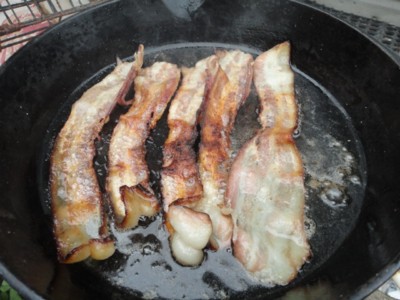
I fried up some bacon over it, and it again impressed me at just how quickly it heated and cooked the food.. one of the claims was that it produced very little smoke, I did find that it smoked a bit on my first try but I have to agree that the second time with dry wood, it was impressive at how little smoke it gave off, but that bacon sure smelled good 🙂 Once it was finished I took out some of the fat and threw in cut off the cob fresh corn to fry up as a side dish, and it did a lovely job on it.

I will be looking forward to trying a few different things cookwise on this little stove,  I have a few different cast iron pots that I would like to try a few things on it, including to see if I can make some flapjacks on it, quick breads are one of the things that if you don’t have a oven, (power out) that need to be able to be made up.. now if its summer, you can use a solar oven but in our cold Canadian winters, you had better have a different plan, I will also do a post on how this stove holds up to cooking in winter time.

My next challange is going to be trying to can a little something in a hot water bath using coal, as I figure it should provide the most stable heat for the learning curve on this one, I am a little leary that it will prove that the size of the oven that burns will be a issue but I still want to try it at least one, I expect that my little potbelly cast iron stove is the better choice for outdoor canning, as it can take a proper typical peice of wood to give a longer burn time, but we will see.

Note: I did not get this stove for free to write about it, I paid full price for it and have no ties to the company etc etc.

Posted in food, frugal | Tagged | 8 Comments

With A Rebel Yell, She Cried: Chores, Chores, Chores…


Chores.


Every farmer has them, and more to the point – he or she has them every day. They don’t go away because you’re sick, or injured, or working late, or just feeling lazy. They don’t go away because your spouse is away or it’s frickin’ cold or there’s a playoff game on. They’ve got to be done.


The trick, of course, is to make it as easy as possible for yourself.


So here are Dear Husband’s tips for efficient and effective undertaking of chores (with apologies to Billy Idol for mangling his song lyrics above):


1. Minimize travel


If you’ve got to haul feed, water, or bedding between locations, it makes sense to minimize the number of trips involved. This will save you time and energy you may want or need for other things. This is partly done by doing everything you need to in one location before moving to a second, rather than going back and forth. You’ll also help yourself by pre-positioning whatever you can at your destination(s) – for example, placing sheep mineral or poultry scratch in a secure location in their barn. Otherwise, find the biggest container you can haul, and use them in conjunction with your wheelbarrow or sled.

Example: Farmgal hit upon the idea of using a couple of those nineteen litre blue water bottles to haul water down to the barn in the deep winter,. The bottles are big, have sturdy handles, and their narrow ends don’t allow for much sloshing out.

2. Know where stuff is

Chores go slowly if you have to spend five minutes each day recalling where you left the pitchfork and the grain scoop the previous day. What you should do is have a specific place to store equipment. Failing that, at least try to leave the equipment in an obvious place.

Example: I bring the water buckets and bottles back to sit beside the tap when I’m done with them.

3. Keep a few basics in your work clothes

Chores don’t always go smoothly. Sometimes something comes up that you need to deal with – a feed bag that needs to be opened, a chicken with some twine wrapped around its leg, etc. Pick up a few inexpensive tools and stick them in the pocket of your work pants, coat, or coveralls. Most times you won’t need them, but when you do need them, you won’t have to mosey back to your toolbox or your house to get them.

Example: At a minimum, I keep a small pocket knife and a tiny LED flashlight in my pocket.

4. Multi-task / Minimize waiting time

Wait times are waste times. If you can initiate a task and then leave it alone for thirty seconds or a minute, there’s probably time to do a second task. This could be something physical, or it could just be observation – a quick glance at your animal to assess its condition and behaviour.

Example: I stick the water hose in the bucket, turn it on, and then go scoop grain into the bird feeder. When I’m done, I go back, turn the tap off, and distribute the water. Of course, if I dawdle too much in that second task, I’ll come back to find the water running over the top of the bucket.

5. Remove or Circumvent Obstacles

An obstacle is something that slows you down or requires additional effort to overcome as you go about your work. Got an old gate latch that you’ve got to fiddle with to open? Replace it. Got metre-high snowdrifts on the path down to the barn? Don’t slog through them; either dig a passage to remove it, or find your snowshoes and sled and circumvent it.

This also applies to your animals, to a degree. If the barn cats are getting underfoot because their food dish is empty – fill it up so they’ll get out of your way.

Example: When at the barn, I give the daily grain rations to the cow, the pig, and any nursing ewes before I worry about anything else. The critters will immediately run to eat the grain, and will otherwise stay out of my way as I fill up their water, top up hay or bedding, or otherwise work in their pens.

6. Don’t Procrastinate

There’s nothing worse than coming home, having a nice dinner, talking with your spouse, relaxing in front of the television or computer, having an evening snack and then realizing you’ve still got to go out and do the evening chores. Chances are your critters won’t be too thrilled with the late service either. Better to do the chores as soon as practical, while you’ve got at least some energy left, and before you start doing something fun. Once you’re done, you can truly relax.

Example: When Farmgal’s away from the farm, I often get home from work, toss something in the oven, and head right out to do the chores (and hey, multi-tasking!). If I get tuckered out by eight o’clock, that’s fine – everybody’s been done.

7. Start Far From Where You Want To Be, and Work Your Way Back

I find it’s a bit of a psychological thing, but I start down at the barn, then do the chores in the little barn, then the chores in the house. Everytime you feel tired and look up to where your hammock or computer is, you’ll be that much closer to it.

8. Reward Yourself

If something fun presents itself during chores, indulge yourself. You’ve earned it, and let’s face it, it might not happen again. Watch the baby birds peeping. Cuddle a rabbit. Drape yourself over the cow. Sneak a few tomatoes from the garden.

Example: In winter, sometimes I just stop between barn and the house and look up at the stars for a minute or two.

9. Develop a Routine, and Stick to it.

Developing a routine stems in part from some of the things I’ve mentioned above, and otherwise do chores in a set way, in a set order. This has a few advantages; first, once you attempt to develop a routine, it’ll gradually evolve towards something you find optimal. If you’re tired, or have something on your mind, you’ll be able to do some of the chores “on autopilot”. You’ll also be less likely to forget something as you go, because you should instinctively know that Chore A leads to Chore B eventually leads to Chore M.

Example: As noted, I feed the cow, pig, and sheep their grain, then their hay, then their water, and finally deal with any bedding/pen requirements. Nothing and nobody gets forgotten, and occasionally, I can zone out and think about a story I’m working on – or even think of a new idea to start writing about.

10. Learn From Others

Well, that’s where you come in. Got some tips to share about doing chores? Help a Dear Husband out!


Posted in farm | Tagged , | Leave a comment

Tag teaming the pressure canner and the water bath canner..

Thankfully, being the weekend, I have my DH also tag-teaming the work, I know that it may seem silly but I do wish that I had a few little ones to be sharing this knowledge with, I wish that my momma lives close enough to say, its a canning day today, come shuck corn or peel beets with me? Alas I typically can most of the time alone when Dh is at work but as we needed to can up about 45 pds of cucumbers, 55 pds of beets and about a 100 pds of corn, I needed some help today..

The corn this year has turned out wonderful…but don’t take my word for it..doesn’t that look great (ok so I picked the best cob to show but still.. its just darn purdy!)

When I meet my hubby, the first summer we did alot of backwoods camping and lots of swapping of stories, my mom on the farm did a garden that was about an acre and half and put up to three thousand jars per season, and I was telling hubby about that I had my own little garden and flowerbed in the big garden from about seven or eight years onward and I asked him about his childhood gardening memories and the one that he told me about was cutting corn off the cob.. so guess what his job was today 🙂 Yup, I shucked, he cut bowlfulls off the cobs, the greens went to the barn critters, some cobs went to the ducks, and chickens, others to the pig, and some went to make corn cob jelly.. lots more to go yet..

Do you like beets, I do, I will let you in on a secret on how to make amazing canned beets, don’t boil them before slipping the skins, bake them instead..  I made 2 dozen jars of regular pickled beets, a big batch of spicy Port Pickled beets, little tiny whole baby beets canned as is, bigger cut into slices and canned plain or with just a touch of cloves.. There is such a pleasure in the middle of winter in openning a can of beets, heating them up, and a tiny bit of butter, salt/pepper and itty-bitty drizzle of vinager and they are meal onto themselves.

The first good picking of elderberries are heading to the freezer and will be done up early this week, talked to my dad today, and he says that he found a patch of wild strawberries where he is working up in northern B.C. and that the flavor was amazing.. I’m amazed that he still have them ready at this time of year? but glad he got to enjoy that amazing flavor.

I’m running out of counter room, guess we will need to slow down and just do some cleaning an prepwork before moving the ones done into the dining room table and then starting again after outside chores are done.

Did you can anything this weekend? and if you did so, did you get to share your kitchen space with your loved ones? Are you teaching the little ones in your house how to perserve their own food?

Posted in Canning | Tagged , , , , | 9 Comments