Why? What is the purpose of this.. open to thoughts..

As I look at the sheep flock walking by, one of the young ewes whole backside is covered in poo, she is the third one in less then two weeks to have this happen..the first time I was O  my gosh and we cleaned her off and checked her all over,  took temps and found her in perfect shape but with loose stools..huh.. ok..

The pasture is growing and they are on eating lots of fresh stuff, so these things can happen.. then about a week after that, I could not help but notice that in my smaller flock, who is on  different pasture also had a very runny covered butt, and this was strange to me as the day before all was well and again she seemed perfectly healthy and in fact both girls have seemed really bouncy after about 24-48 hours.. and I have been keeping a close eye on them trying to figure out what is the cause..

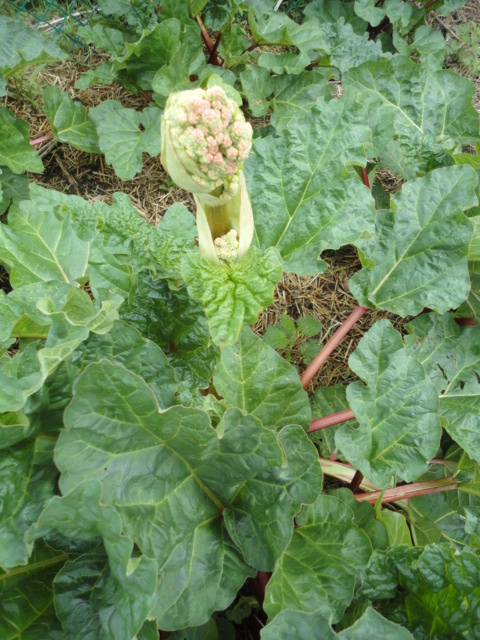
Then I saw it, one of my girls pushed her way though the sheep fence and the green fence to nibble -Wait for it.. rhubarb leaves, not alot, she took maybe three bites and then walked away.. and yup, she now had very loose stools but otherwise is bouncing around and good mood.. are they self-medicating somehow? and if so, for what!

I have a small area that I grow a number of self-medicating plants for the sheep and they get limited graze in their off and on, the last time I put them in, they all wanted burdock and wormwood, along with some nettle and then headed back out to the main pastures.. hmmm, according to my books, they should not! want to get rhubarb leaves and I am NOT recommending you ever feed them to anything!..

But I am finding it very interesting that they are making this choice, they have good pasture, plus hay, so trust me this is not about wanting fresh greens, this is something else..  Its certainly a intense choice for a spring clean out and I will need to consider putting up a layer of green fencing along the sheep side to keep them out.

Posted in Life moves on daily | 4 Comments

Baby Bunny Update

Well, lets get the bad out first.. my wonderful brown doe was very much expecting, and she pulled a nest and I was sure she was going to have little ones, and then I waited and kept checking on her, she was eating and drinking and friendly…sigh.. and I went to bed, and the next morning when she was checked on, she was gone, having passed away in the night, clearly something had gone very wrong in the pregancy and or birthing process.

Now I have read this can happen in my rabbit book but it was a first for me and to be honest a bit of a shock, given that she had seemed so bright eyed the night before and was happy to see me and my bit of fresh greens and i saw her have a drink of water and knew by the feed dish, that she has been eating during the day… but none the less, she was gone and I had a huge moment of guilt, as I was the one that breed her.. which as DH pointed out, if she was in the wild she would have breed and in truth more often then I breed my does. Still every time I walk by her hutch, which is a number of day, I keep waiting for her to appear and say hello, that empty hutch is SO! empty at the moment..

However has life often happens on the farm, across the way in her own hutch, my other doe has given birth to a lovely little of little ones.. now they have a huge bed of pulled hair, I barely checked the nest as it has been on the cool side and didn’t want to bother the babes.. Today was the first day for ok weather, its been raining and as you can see the little ones are plumb and just starting to get their coats in.. more photos in a week when they have fur and their eyes open.. somewhere in that nest is my new keepback doe, and I am looking forward to find it..

Posted in Critters | 6 Comments

O how quickly folks are to judge- Water Bottle’s

As I sit here sipping water out of my “glass” glass gotten at a farm sale for less then a cent in cost, filled with my own well water, listening to cracking thunder, and the patter of my old boy hound that hate thunder, singing birds, and when you look at the windows, field of green has peacefully grazing sheep and out the other, all you can see if my huge almost in bloom apple tree

It peaceful, as most folks that read the blog know I keep a well-stocked pantry and that includes both stored water and included in that is X number of bottle water cases for those “just in case” ..but something  has happened over the past couple weeks, that dated water needs to be rotated out and drank.. wow, I can’t believe the looks and even the odd comment I am getting about drinking bottled water..

One of part of me almost wants to pour the bottled water into the steel bottle and just haul it around like normal but the other part of me is stubborn.. and I have now had at least one small child very sweetly explain to me that its bad, looks from folks and even a “not cool” from a guy I don’t know from adam..

There is a part of me that is kinda wow on this.. is plastic bottles the new smoking?  Have we in fact reached a massive level of “frown face” that being seen with one of these is enough to get you judged..

I guess part of the reason, I refuse to just pour it into the steel bottle is because I in fact know how much I do in my daily life to reduce my green “footprint” and I find being judged on something so simple to be on the vaguely amusing side.. its kinda like peaple watching in reverse..

Speaking of doing things that are not normally done, I am thinking about lettting one of my best rhubarb plants go to seed this year and try and grow baby plants from seed- Yes, I know that they don’t grow true but I might get one or two new plants that are ideal for my farm and then I can grow them and split them for many years to come.. anyone done this in the past or working on that project now?  Can’t believe how many of them are trying to go to seed already in early may! At least they are ready for their first picking, boy the strawberries plants are slow this year though.. not sure why..

Posted in Life moves on daily | 4 Comments

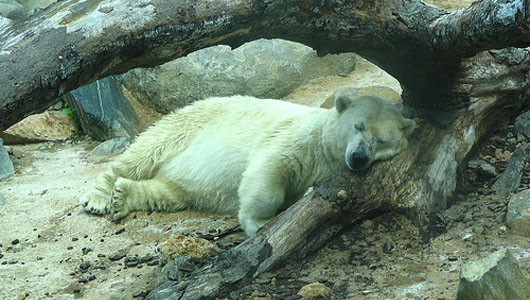
You know that old saying “Life will find a way” Introducing the grolar bear..

If you thought the mule was the only hybrid animal roaming around unfettered, well, you’d be mistaken. BBC News reports that hybrid combinations of polar and grizzly bears are peppering zoos across the world and, in one case, even occurring in the wild. Germany’s Osnabruck Zoo is the site of a study of the mysterious mammals (resulting when the two species, housed close together, engaged in some unauthorized hanky panky). Dr. Ute Magiera, conservation coordinator of the facility, says this particular hybrid is very rare, with only 17 confirmed animals in existence.

The first Osnabruck “grolar bears” were the children of a female brown bear and, evidently, a male polar bear. Born in 2004, the cubs were the first hybrids to show up after nearly 25 years of the two species’ cohabitating. Researchers observed the cubs and found that the hybrids are a bit smaller than the polar bears, have long necks like their polar parents, but have the shoulder humps typical of brown bears. Other features include thicker heads (like grizzlies), visible tails (like polars), and blended feet — partially insulated with hair like the polar bear, partly long-toed like the grizzly.

BBC News reports that the most interesting feature of the hybrid is the hair. Polar bears typically have hollow hair shafts while brown bears have more solid hair shafts. The hybrids have a blended coat that varies depending on the bear’s sex and body part. Males had solid-haired paws with hollow-haired backs while females had largely hollow hairs. When it comes to behavior, the bears seem to act more like polar bears, using their front paws to stamp in the ways polar bears break through ice and tossing toys around with their teeth the way polar bears rattle their prey.
So why should we care so much about the minutia of a hybrid born of two species whose habitats rarely overlap in the wild? BBC News suggests that climate change is shifting the locale of the polar bear, drawing the bears more inland. These shifts might happen too quickly for the species to adapt, but if the bears are able to successfully mate with other species, these hybrids could have interesting implications for adaptation and evolution.
Life will find a way -O ya baby!

Hunters from the village of Ulukhaktok, N.W.T. knew there was something different about the polar bear they were stalking but couldn’t put their finger on it.   It was far more aggressive than anything they were used to. They even called off the dog for fear the large white mammal would kill it.   On closer inspection after it was shot and killed, it turned out not to be an ordinary polar bear but one that was a cross between a polar bear and a grizzly, unofficial known as “grolar bear” and “pizzly.”

“The first hybrid we had ever seen around here a few years ago was pretty nasty. They (hunters) usually stalk the polar bear using a dog but this bear was so aggressive they couldn’t use a dog on them. It was too dangerous,” Robert Kuptana, who lives in the western Arctic hamlet of about 400 people on Victoria Island, told the Toronto StarFriday.

Over the years as grizzly bears have wandered further north following the Caribou herd, the hybrid variety has become more common, the 69-year-old Kuptana said, adding that just 10 days ago, a hunter from the village, Pat Ekpakohak, and his two grandchildren killed three of them.   “One is pure white, one is partly dark and the other is fairly dark brown and the top part is white,” said Kuptana, who took a picture of the skins. Polar bear and grizzly habitat overlaps in the western Canadian Arctic around the Beaufort Sea. Grizzlies are known to occasionally to go out on the ice in the spring to feed on seals killed by polar bears, according to the Canadian Wildlife Service.

A DNA test conducted by the Wildlife Genetics International in British Columbia on a bear shot and killed by an American hunter in 2006 confirmed it was a hybrid, making it the first documented case in the wild.   Ian Stirling, a research scientist and polar bear expert with the Canadian Wildlife Service in Edmonton, said in an interview with National Geographic that the hybrid was “definitely not” a sign of climate change.   Andrew Derocher, a professor of biological sciences at the University of Alberta, is in Ulukhaktok, where he is doing polar bear research and saw the skins from the three hybrids.   He told the Star, “It seems to me they are getting a lot more common, at least in this part of the Arctic.   “I think the story here . . . is that the number of grizzly bears on Victoria Island has increased quite markedly over the last 20 years. And part of that might be related to changing environmental conditions up here. It’s a bit warmer and it’s quite clear the grizzly bears are well-established here now and, of course, there is a healthy population of polar bears around,” he said.  David Paetkau, president of Wildlife Genetics International, based in Nelson. B.C., told the Star it was a “quirky” development that can’t be totally explained and that he was only interested in talking about substantive work that his firm does.

So here is my question, is it in fact a mule or can these hybreed make babies, and if so can they cross back and forth on which both breeds… so if the first DNA proven bear was in 2006 but the hunters can take four in a matter of a two weeks, there has to be alot more of them up there on that island and if that can happen there and in the zoo, it can certianly happen in other areas if climate change effects the plant and animal growth, its like the killer whales moving in ever increasing numbers up in the Canada north do to the changing sea ice.. hmmm, going to have to follow this one as more info becomes available..  Now we have half wolf-half coyotes in ontario/quebec within proven DNA moving back down into the upper eastern states with the daughter mix outpacing their parent species, wonder if that is what we will slowly see happen in regards to this mix, the best of both mixed into one package..

Posted in Life moves on daily | 6 Comments

Wild Food- Food Banks

Now I am going to give a heads up that while I will do my best to be careful in my wording on this subject, I know that I could and most likely will cross that PC line so if you read it and think, that was mean or whatever, know that I am writing with the best thoughts in mind and that words on a page can be hard to get right..

First a story from my childhood, one of the things we picked and loved was Pincherry pancake syrup, and if you have never picked them, they are tiny little red berries with a pit and they are so! sour, that to eat one raw will pucker your mouth and make you spit a number of times at a min.. the whole family was out at a local campsite that had lots of wild pincherry tree’s and we were all picking away, there was a couple in a motor home, and the wife watched us doing this and sent the hubby over to get her some, he avoided us and walked over to a patch a bit down the road and picked some,didn’t answer our smiles or hello’s and took his handful back to the wife, who put them all in her mouth and chewed, and then spent the next bite spitting and coughing and rinsing her mouth, while making comments about crazy Canadians.

Now we all thought it was funny, because if they had just bothered to ask us, we would have happily explained what they needed to do and even shared the recipe etc, as I have grown up and I see folks watching me wild craft in the outdoors, I have often thought of this as I have seen or overheard folks say, she picked that,  grab some and let try it.. but what they don’t know is that I am going to blanch that once or sometimes twice before use to take the bitterness out, that I not going to eat it but make a salve with it, or that those roots I am digging are not for raw eating or cooked eating but are for drying and use in a tea etc..

Its the pincherries all over again, folks see, and folks do but they don’t have the rest of the story.. I got thinking about all these tree’s that Hidden Harvest is planning on working with (and I do think this is an excellent program, and I can already tell the odds are I will get more involved in the program itself because I do believe in it) but it got me to thinking about that the fruit picked while miles above what you can get in the store in terms of freshness, will not look at all like the fruit in the stores, it won’t taste like it either.. many times different trees in wild area are from seed and you never know what you are going to get.. Some will be more sour, some will be small, some will have more seeds, thinner or thicker skins and if the fruit has not been sprayed and looked after, then we will have lots of buggies, and worm holes and brown spots in the apples etc.

Unless you want and know how to use sour plums, browned spotted apples, tiny little crab apples, or cherries that are have ready right now, and some that are not quite ready, because that is the truth, I mean look at my own grapevines, when I cut the clump, 10 to 20 percent not ready, 10 to 20 percent overripe, and 40 to 60 percent perfectly ripe, which makes me wonder just how much get cut off and throw away for us to get that perfect clump of grapes in the stores.

So lets assume that we give that bag or box of tiny crabs apples to folks in need of food.. and then get it home and now what! They can’t eat them fresh, they can’t make a pie with them, which means they need the rest of the story and the training and equipment to choose to

  • Make homemade pectin with them
  • can them so they can be eaten whole
  • Cook them, screen them and make crabapple sauce with them
  • Cook them and get crabapple juice from them.

All of the above they are still going to require some kind of sweeter added to them to make them so you can eat them in any kind of amounts..

Which means you have now asked folks to have jars, screens, linens, sugar or honey etc. plus the spending the powder heating costs assuming they have a working stove etc..

The nuts are not different, I have cracked black walnuts, I know folks drive them over with car around here LOL and let me tell you , its work, steady, not easy work.. so while it sound amazing.. we can pick up XX amount of pds of this kind and that kind of nut,  how do you get it from the raw nut into a workable form for use?

Try and picture it.. worked nine hours on your feet in a store, picked up the kids from school, made supper, you are tired, and want to just watch an hour of TV or read a book, how likely are you really to sit down and spend hours cracking nuts.. I mean we have a heck of time get folks to even save and use their pumpkin seeds, and they are super easy to prepare and eat compared to nuts..

I love the idea of so much of this food finding its way into food banks and lower-income families where it’s needed but I think without training and making sure that you find the right people that its given to, that it’s just wishful thinking.. and in truth I worry that much of it will just be thrown away when they get it home.

Now I know that Callie K has got some first hand knowledge in this area, so I am really looking forward to hearing her thougths on this?


Posted in food | 9 Comments

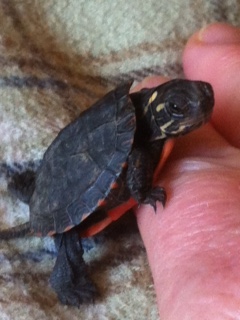
Eastern Painted Baby Turtle -Guest Post by Deb

This little guy’s shell was barely the size of a quarter across (I measured; it’s only one inch from one side to the other where his back toes are) and so freshly hatched, he was still dirt-smudged from digging out.  SO CUTE!!  But, as you can (hopefully) see from look in his eye, he really was a man on a mission; so he got a lift to the pond right after his photo shoot, Photo Credit and note given to Deb Weyrich-Cody

“farmgal” Wow, have you ever seen such a cute baby turtle, I have seen these turtles in a number of ponds in the local forest by me and a few of them had signs that went up that they were active breeding/hatching grounds but I have never really seen anything but the adults or half grown ones.. Maybe I will try to find out more over this year and see if I can plan a stake out hatching event.. I have a really amazing trail camera thanks to my dad and it could be placed carefully so I don’t lose it, if I can find a nest and maybe just maybe I could have a series of live hatching photos of the little ones coming up..

thanks so much for sending the photo and info and for saying yes when I asked if I could share it publicly!

Posted in Life moves on daily | 3 Comments

Hmmm, Could be producing thousands of pds of food annually or ……..

Dh sent me this note, I just shook my head, Silly peaple, we could have thousands and thousands of pds of fruit produced in city every single year, and instead we have a program that is helping make peaple sick in record numbers.. So glad that we picked and planted all our tree’s and bushes with food production in mind.
Here’s an article in the Ottawa Citizen:  http://www.ottawacitizen.com/health/Health/6575229/story.html.  Is it not ironic that modern cities prefer (male) trees that create allergies to (female) trees that create fruits and nuts?
Here’s the text:
OTTAWA — There’s a biological war of the sexes raging in Ottawa’s trees, and people with pollen allergies are the casualties.

A huge majority of the trees here — and in many Canadian and U.S. cities — are male.

Female trees are messy. They are the ones whose flowers go on to produce nuts, seed pods, apples and other seed-carrying debris that people don’t like to sweep up off decks and patios or scoop out of clogged eavestroughs.

So growers have switched to supplying male trees, which don’t produce seeds.

Instead, the male trees produce pollen. And that aggravates allergies.

Tom Ogren, a horticulturalist from California, came to Ottawa this week as part of a cross-Canada tour sponsored by the makers of Reactine allergy medicine.

The average male tree produces an amount of pollen equal in weight to the female tree’s seeds, he says. But the pollen is mostly invisible.

Ogren doesn’t have allergies, but his wife of 45 years does. Years ago this gave him the idea of searching for the most pollen-free plants for his own home, and eventually for other people as well. He writes books on the subject.

But a funny thing happened when he went out to shoot pictures of male and females samples of each species. Near his California home he had trouble find the females.

“I thought maybe my city was unusual,” he said in an interview. But the same weirdly skewed population showed up in city after city — anywhere that the trees had been purchased from growers instead of growing naturally. It doesn’t occur in rural areas or small towns.

Ogren calls it “botanical sexism,” and he says it contributes to needless suffering by anyone with allergies to tree pollens.

On Wednesday, he toured Ottawa to see what kinds of trees we have in our parks, schoolyards, nurseries and streets.

In a word, they’re male. At least most of the time.

That goes for a huge variety of trees and shrubs — juniper, horse chestnut, katsura, yew, ginkgo, ash, oak, aspen, poplar, honey locust, Manitoba maple, mulberry, and on down the list.

In some cases growers have even found a way to produce “all-male” versions of a tree that’s naturally both male and female, he said.

The locust, for example, naturally produces male branches and female branches on the same tree. It doesn’t occur in nature in an all-male or all-female version. But growers have learned to cut off a male branch and clone it, producing new trees without female branches.

Manitoba maple isn’t usually planted here, so he suspects the male majority came through “chainsaw selection” when people cut the trees that drop seeds and leave the seedless (male) trees standing.

The emerald ash borer infestation leaves Ottawa at a crossroads, he notes.

“I’ve driven through Ohio, and just about every ash tree they have — green ash, black ash, white ash — is either dead or dying” from the emerald ash borer infestation.

Ottawa’s urban forest is about one-quarter ash, “and I expect the emerald ash borer is going to do a number on most of them.”

That leaves the question of what to replant. Go with more female trees for a healthier environment, he suggests. Not only do they not produce pollen, but they attract it and clean the air of the tiny particles, and even smaller particles of airborne soot from vehicles that cling to them.

Posted in Life moves on daily | 4 Comments

Garden Monday- Apples/Ontario, Sea of Blue and Plants Swap..

Well, we all worried that this would happen, and here is the lastest news.. Sigh..

“A catastrophic freeze has wiped out about 80 per cent of Ontario’s apple crop  and has the province’s fruit industry looking at losses already estimated at  more than $100 million.

“This is the worst disaster fruit growers have ever, ever experienced,”  orchard owner Keith Wright said Friday.

“We’ve been here for generations and I’ve never heard of this happening  before across the province. This is unheard of where all fruit growing areas in  basically the Great Lakes area, in Michigan, Pennsylvania, New York State,  Ontario, are all basically wiped out. It’s unheard of,” the Harrow, Ont.-area  grower said.

Wright lost hundreds of thousands of dollars worth of apples and peaches last  Sunday when freezing temperatures killed the blossoms.

Warm temperatures got fruit trees blooming early and when temperatures  plummeted it damaged or wiped out much of the $60 million apple crop and 20 to  30 per cent of Ontario’s $48 million tender fruit crop, which includes peaches,  cherries, pears, plums and nectarines.

Brian Gilroy, a Georgian Bay area apple grower who is chairman of the Ontario  Apple Growers, said the loss to fruit growers and the economy will easily be  more than $100 million. On top of the lost yield or no crop at all, orchard  workers and spinoff industries such as juice, packing, storage and farm supplies  will be affected.

Gilroy said consumers will find locally grown apples pricey and difficult to  find this fall. Some kinds of apples such as Empire will be very difficult to  find.

Washington State has a good crop but consumers should expect apple prices to  jump because all of northeastern North America was affected, he said.

What crop growers do get will likely have visible damage such as apples with  ridges like the ones on pumpkins.

“This past weekend in southwestern Ontario and the Niagara region  temperatures got down to close to -7 (C) while things were out in full bloom and  it’s pretty well wiped them out,” Gilroy said of orchards already hit by  previous frosts. “It’s very widespread and the worst that anybody’s seen.”

Gilroy said about 65 per cent of the 215 commercial apple growers in Ontario  have crop insurance but the disaster has the board approaching the provincial  and federal governments for help under an agri-recovery program.

Some growers across Ontario have also lost entire orchards of peaches, sour  cherries, pears, plums and nectarines, said Phil Tregunno, chairman of the  Ontario Tender Fruit Producers Marketing Board.

It depended on location. The board is estimating 20 to 30 per cent of that  $48 million crop is done.

“It was just way too early,” Tregunno said of blossom season that came about  a month early. “That just put us at a huge risk.”

Dave Nickels of Nickels Orchards in Ruthven, Ont., said he lost all his  apples, peaches, cherries and pears. He said when talking to other growers you  can’t even get a word out of them because they’re just sick.

“It’s kind of like having a death in the family except there’s no closure to  this one,” Nickels said.

In some varieties there is still a chance to get some apples. In early June,  trees shed excess fruit as a natural thinning process and growers will have to  wait to see if shocked trees will drop all their fruit, Wright said.”

For myself, I am sitting ok at the moment, my plum and cherry’s are just now starting to bloom, and the night time temps are looking good, my apple tree’s are behind the plums/cherries.  Still, I typically wild pick a fair amount of local apples, it will be interesting to see if my local wild apple tree’s got hit or were slower to go like my own tree’s on the farm where.

So I arrived home yesterday to a sea of blue that had overtaken a huge sections my garden LOL, my hubby decided to spread out thick heavy blue tarps and weight them down over whole sections of my garden to help start killing off the green cover for ease of planting over the next few weeks, I am unsure  if this will do what he thinks but regardless the soil will certianly warm under it.

This weekend, put a few miles on the van and headed out to meet Deb at a half way point between our places and had a lovely lunch with her and her DH, and then we had a great plant swap of all kinds of great green goodies..

Posted in gardening, gardens | Tagged , , , | 5 Comments

Did you know that this week is Emergency Preparedness Week in Canada?

http://www.getprepared.gc.ca/cnt/rsrcs/ep-wk/tlkt-eng.aspx


Using technology during a disaster

We rely on technology more and more to keep in touch with our family, friends, and colleagues with a click of a button.

But what happens in the event of a major emergency? Suddenly these tools can become vital in helping you and your family deal get in touch and stay informed. So here are some tips on the use of technology in an emergency:

  • If possible, use non-voice channels like text messaging, email or social media. These use less bandwidth than voice communications and may work even when phone service doesn’t.
  • If you must use a phone, keep your conversation brief and convey only vital information to emergency personnel and/or family. This will also conserve your phone’s battery.
  • Unable to complete a call? Wait 10 seconds before redialing to help reduce network congestion. Note, cordless phones rely on electricity and will not work during a power outage. If you have a landline, keep at least one corded phone in your home.
  • Keep extra batteries or a charger for your mobile device in your emergency kit. Consider getting a solar-powered, crank, or vehicle phone charger. If you don’t have a cell phone, keep a prepaid phone card in your emergency kit.
  • Keep your contacts up to date on your phone, email and other channels. This will make it easier to reach important contacts, such as friends, family, neighbours, child’s school, or insurance agent.
  • If you have a smartphone, save your safe meeting location(s) on its mapping application.
  • Conserve your smartphone’s battery by reducing the screen’s brightness, placing your phone in airplane mode, and closing apps you are not using. You never know how long a power outage will last!

Remember, in an emergency or to save a life, call 9-1-1 for help. You cannot currently text 9-1-1. If you are not experiencing an emergency, do not call 9-1-1. If your area offers 3-1-1 service or another information system, call that number for non-emergencies.

Facts about emergency preparedness

Emergency Preparedness Week 2012 marks the 17th annual event. Here are some interesting facts to mark 17 years of getting better prepared for emergencies.

  1. Roughly 5,000 earthquakes are recorded in Canada every year.
  2. Canada gets more tornadoes than any other country except the U.S., averaging about 50 tornadoes per year.
  3. The worldwide cost of natural disasters has skyrocketed from $2 billion in the 1980s, to $27 billion over the past decade.
  4. Canada’s first billion dollar disaster, the Saguenay flood of 1996, triggered a surge of water, rocks, trees and mud that forced 12,000 residents to evacuate their homes.
  5. Some hailstones are the size of peas while others can be as big as baseballs.
  6. Approximately 85% of Canadians agree that having an emergency kit is important in ensuring their and their family’s safety, yet only four in ten have prepared or bought an emergency kit.
  7. In 2011, flooding in Manitoba and Saskatchewan featured the highest water levels and flows in modern history. Over 11,000 residents were displaced from their homes.
  8. Ice, branches or power lines can continue to break and fall for several hours after the end of an ice storm.
  9. The deadliest heat wave in Canadian history produced temperatures exceeding 44ºC in Manitoba and Ontario in 1936. Rail lines and bridge girders twisted, sidewalks buckled, crops wilted and fruit baked on trees.
  10. In 2007, the Prairies experienced 410 severe weather events including tornadoes, heavy rain, wind and hail, nearly double the yearly average of 221 events.
  11. The coldest temperature reached in North America was –63ºC, recorded in 1947 in Snag, Yukon.
  12. The largest landslide in Canada involved 185 million m3 of material and created a 40m deep scar that covered the size of 80 city blocks in 1894 at Saint-Alban, Quebec.
  13. Hurricanes are bigger and cause more widespread damage than tornadoes (a very large system can be up to 1,000 kilometres wide).
  14. 85% of Canadians agree that having an emergency plan is important in ensuring their and their family’s safety, yet on only 40% have prepared one. Complete yours online at http://www.GetPrepared.ca.
  15. One of the most destructive and disruptive storms in Canadian history was the 1998 ice storm in Eastern Canada causing hardship for 4 million people and costing $3 billion. Power outages lasted for up to 4 weeks.
  16. The June 23, 2010 earthquake in Val-des-Bois, Quebec produced the strongest shaking ever experienced in Ottawa and was felt as far away as Kentucky in the United States.
  17. Using non-voice communication technology like text messaging, email, or social media instead of telephones takes up less bandwidth and helps reduce network congestion after an emergency.

Emergency Management in Canada: How does it work?

In a country that borders on three oceans and spans six time zones, creating an emergency response system that works for every region is a huge challenge. ­That’s why emergency management in Canada is a shared responsibility. ­That means everyone has an important role to play, including individuals, communities, governments, the private sector and volunteer organizations.

Basic emergency preparedness starts with each individual. If someone cannot cope, emergency first responders such as police, -re and ambulance services will provide help. If the municipality needs additional assistance or resources, they can call on provincial/territorial emergency management organizations, who can seek assistance from the federal government if the emergency escalates beyond their capabilities. Depending on the situation, federal assistance could include policing, national defence and border security, and environmental and health protection.

Requests for assistance from provincial/territorial authorities are managed through Public Safety Canada, which maintains close operational links with the provinces and territories. It can take just a few minutes for the response to move from the local to the national level, ensuring that the right resources and expertise are identified and triggered.

Everyone responsible for Canada’s emergency management system shares the common goal of preventing or managing disasters. Public Safety Canada is responsible for coordinating emergency response eorts on behalf of the federal government. More information is available on the Public Safety web site at www.publicsafety.gc.ca (click on “Emergency Management”).

.

This week, I encourage you to take concrete actions to be better prepared. Please do your part! Experience has shown that individual preparedness goes a long way to help people cope better – both during and after a major disaster. Get an emergency kit now – it can make a world of difference.

 Quiz

1. A family emergency plan should NOT include which of the following?

  1. Information about your children’s school(s)
  2. The name and phone number of an out-of-town contact person
  3. A list of important phone numbers, including those of doctors and emergency services
  4. Arrangements for each person in the family to be at a specific land line telephone at a specific time
  5. A meeting spot outside your home and one outside your neighbourhood in case you need to leave the area

The answer is D. The arrangements for each family member to be at a specific land line telephone at a specific time may not be possible or useful under many conditions, as people may have to relocate or evacuate entirely during a disaster. Families should create an emergency plan and carry important information with them so they know how to get in touch and get back together during an emergency. Finally, both telephone land lines and cellular phones may be overloaded or out of service during or after an emergency, so knowing in advance where to meet is important.

2. How many litres of water per day per person should you have in your basic emergency kit?

  1. 1 litre per day per person
  2. 3 litres per day per person
  3. 2 litres per day per person
  4. 4 litres per day per person

The answer is C. At least two litres of water are recommended per person per day. (Include small bottles that can be carried easily in case of an evacuation order.)

3. Which tool allows you to learn about historical information on disasters which have directly affected Canadians, at home and abroad, over the past century?

  1. Weatheradio
  2. Canadian Disaster Database
  3. Natural Hazards and Emergency Response
  4. Disaster Management Canada

The answer is B. The Canadian Disaster Database references to all types of Canadian disasters, including those triggered by natural hazards, technological hazards or conflict (not including war). The database describes where and when a disaster occurred, who was aff­ected, and provides a rough estimate of the direct costs.

4. When does Emergency Preparedness Week (EP Week) occur?

  1. First full week of February
  2. First full week of September
  3. Last full week of February
  4. Last full week of May
  5. First full week of May

The answer is E. EP Week is an annual event that takes place each year during the first full week of May. This year it takes place from May 6-12, 2012. EP Week is a national awareness campaign coordinated by Public Safety Canada and is about increasing individual preparedness – by knowing the risks, making a plan and preparing a kit you can be better prepared for an emergency.

5. Which of the following items should NOT be included in a basic emergency supply kit?

  1. Water (two litres of water per person per day)
  2. Food
  3. Manual can opener
  4. Cash
  5. Comfortable shoes

The answer is E. While sturdy protective shoes are important during and after a disaster, they are not necessary for survival. You can learn more about the basics of survival by visiting http://www.GetPrepared.ca.

Fact or Fiction: Are the following statements true or false?

Q1 – Water can be purified with soap.

False – Boil water for 10 minutes or disinfect water by adding unscented bleach. Add 3-4 drops of bleach per litre of water with an eyedropper (do not reuse eyedropper for any other purpose). Mix well and let stand for 30 minutes. The water should smell faintly of chlorine. If it does not, repeat the steps and leave for another 30 minutes.

Q2 – You can walk through moving flood waters as long as the water level is no higher than your waist.

False – One of the worst floods in Canada’s history occurred in July 1996 in the Saguenay River Valley, in Quebec. Ten people died and 15,825 others were evacuated when flood waters swept through thousands of homes, businesses, roads and bridges. The flood was caused by 36 straight hours of heavy rainfall, for a total accumulation of 290 mm (approximately to the knees). Estimated damages: $1.5 billion.

Q3 – Tape prevents window glass from shattering during a hurricane.

False – Storm shutters can be put into windows and exposed panes. This is the simplest and most economical way to protect your house.

Q4 – Roughly 5,000 earthquakes are recorded in Canada every year.

True – Although the most powerful earthquakes occur near the Pacific Rim, there are a number of Canadian cities that are vulnerable to earthquakes, particularly Vancouver, Montreal, Ottawa, Victoria and Quebec City. Most of the injuries resulting from an earthquake are caused by falling objects. Use screw eyes and iron wire to hang frames and mirrors on walls.

Q5 – Tornadoes occur only in the spring.

False – Tornadoes occur most often in the spring and during the summer, but they may form any time of the year.

Q6 – Destructive hail storms occur most often in late spring and in the summer.

True – In June, most hail storms occur in southern Canada and the north central United States. Violent storms may deposit enough hail to completely cover the ground, damage crops or block storm sewers. Up to 2% of the value of crops is destroyed by hail every year

So do you have a 72 hour kit? After Reading this, can you spot a weakness in your plans, mine is needing to work on the pantry in terms of earthquakes this year.. we have had at least four earthquakes on the farm since we got it that have been felt and even heard, and I have not done near enough to make sure to protect my jars from falling and breaking.. I will update on this goal as I make process on it..  I am also currently rotating out my bottle drinking water, feels kinda weird to be taking plastic bottles with me as I normally drink out of the steel bottles but that water’s due date is coming and I am not going to throw it away, and we will replace it with fresh dated cases  into our storage.. Remember, we can go without food for alot! longer then we can without water!
Posted in Just in Case | 5 Comments

Anyone want to plan a weekend getaway in the fall?? Sept 22 an 23rd?

I’m really thinking about making this seminar, if anyone else thinks they might like to join me, a) I will carpool if you are local to me and b) willing to share a room, we could all book the same place and have a nice dinner and visit in the evening.. Drop me a note by email if you have it or leave me a comment on the blog.. might a great way to learn lots, get to visit a off-grid home, and have a girls (guys welcome but not in the overnight room part) weekend!

Upcoming Intro-to-Permaculture Courses at Greenshire: May 12th and September 22nd If you are interested in learning how to live sustainably and beyond, if you’d like to learn environmentally friendly ways of providing for your own basic needs, if you’re thinking about taking a permaculture design course but are undecided…Then this is the course for you!

Our two-day course will cover:

The Permaculture Ethics and Principles Observation skills building/Site analysis for both urban and rural environments Design methods – including a group design project, and how to apply these techniques to your situation

 Practical examples of permaculture Forest gardening basics

Plant walk – forest garden tour, plant identification, polyculture and guild examples

 No-tillage, minimum tillage, and minimum/no irrigation techniques

Off-grid power generation, passively heated greenhouse construction

Ecologically friendly building design examples

There will be a mix of classroom and hands-on learning using our 100-acre permaculture farm to showcase permaculture in action.

There will also be a field trip to a nearby off-grid homestead, and a stop on the way to see a straw bale building.

About the Teacher: Travis Philp has been wild-crafting and farming professionally, using permaculture techniques for four years. He has two diplomas from Fleming College: Ecosystems Management Technician and Environmental Technician. He received his Permaculture Design Certificate at the Living Centre near London, Ontario. Spring Course

Times: Saturday May 12, 8 am -12 pm, 1 pm-6 pm Sunday May 13, 8 am -12 pm, 1 pm-6pm Fall Course Times: Saturday Sept. 22, 8 am -12 pm, 1 pm-6 pm Sunday Sept. 23, 8 am -12 pm, 1 pm-6pm COST- $50 (bring your own lunches) or $75 (lunches included for Saturday and Sunday)

If overnight accommodations are required, please inquire. *This is NOT a full Permaculture design course, therefore we cannot award a Permaculture Design Certificate upon completion of the course.

Posted in farm | Leave a comment