Green Expo coming up

The Ottawa Green Expo will take place March 19th and 20th  in Lansdowne Park.

The Ottawa Green Expo is the first of it’s kind in Ottawa! This exciting, 2 day event features hundreds of exhibitors, all dedicated to providing information, products and services that can help you live a greener lifestyle! With everything from home and garden ideas, eco-friendly food and clothing, transportation options, organic food and cooking, to guest speakers and interactive displays the Ottawa Green Expo offers many simple ways of going green and helping our environment!

Make a day of it; bring your friends and family and learn to “Go Green”.

Event Features include: Green Homes & Gardens, Solar Zone, Local & Organic Marketplace, Green Building, Energy, Green Business, Transportation Zone, Wellness Zone, and Eco-Fashion!

http://www.ottawagogreenexpo.com/ottawa/cooking_stage.pdf

Like to cook, check out that cooking stage info listed above.. I have gone before, and personally found that its a good mix between checking basic cooking skills combined with some very interesting ideas on how to bring out those wonderful flavors and textures. DH tends to like the other stage better.

Posted in Life moves on daily | Leave a comment

Chickweed

Chickweed is very nutritious and is used in salads and soups, in the raw form. Apart from the use of its fresh form as salad green, chickweed can be added to tea. It is one of the ones that tastes good, with little to no bitter aftertaste (at least to me) It is very healthy, they say that it contains many nutrients, healthy components, Proteins, fiber, essential fatty acids, etc. It contains saponins, gamma-linolenic acid (GLA is a type of omega-6 fatty acid), coumarin, flavonoids (rutin), hydroxycoumarin, etc. along with a host of minerals and Vitamins

It is a rich source of aluminum, Calcium  chromium, copper, magnesium, manganese, iron, silicon and zinc. Moderate amounts of Vit A , B vitamins,  Vit C chlorophyll, potassium and fiber are also found in this plant. The saponins reduce the thickness of the cell membranes, facilitating the increased absorption of nutrients and also cleanses the body by dissolving the plaque in arteries, fats and other toxic materials.

On the farm, everyone likes their chickweed including the birds and the four footed critters.

The history of chickweed health benefits can be traced back to the sixteenth century, when people used this herb for soothing inflammations, skin conditions and some other diseases, modern herbalists recommend this plant for the treatment of various medical conditions, even though none of them is scientifically proven. Owing to the popularity of this herb and its health benefits, chickweed is now available in the form you can think of at the health food store but the fresh form is considered to be the best. Remember to use any new plant with care, Always try a tiny amount and then give yourself time to see if you have any reactions.

Posted in Herbs | Tagged | Leave a comment

March 18th-Onions and Garlic

So I looked over my lists and thought about something to write about today, that I would not want to be without in my pantry, and Onions, Garlic and Chives would be on that list.

Onions were orginally native to Asia and the Middle East and they think that they have been grown and collected for around five thousand years. Onions were highly regarded by the Egyptians. they used them as currency to pay the workers who built the pyramids, and also placed them in the tombs of kings, such as Tutankhamen, so that they could carry these gifts bestowed with spiritual significance with them to the afterlife.

Onions have been enjoyed throughout time not only for their culinary use, but also for their therapeutic properties. As early as the 6th century, onions were used as a medicine in India. While they were popular with the ancient Greeks and Romans, they were oftentimes dressed with extra seasonings since many people did not find them spicy enough. Yet, it was their pungency that made onions popular among the common folks throughout the world who could freely use this inexpensive vegetable to add flavor to their meals. Onions were an well used/actively grown vegetable in the food  of most European countries during the Middle Ages . Christopher Columbus brought onions to the West Indies; their cultivation spread from there throughout N.A.

Onions, like garlic, are members of the Allium family, and both are rich in sulfur-containing compounds that are responsible for their pungent odors and for many of their health-promoting effects. A wide variety of allyl sulfides are found in onion, including the four major diallyl sulfides: DMS (diallyl monosulfide), DDS (diallyl disulfide), DTS (diallyl trisulfide), and DTTS (diallyl tetrasulfide). Also present are a wide variety of sulfoxides, including (+) S-methyl-L-cysteine sulfoxide (MCSO), (+)-S-(1-propenyl)-L-cysteine sulfoxide (PRENCSO), S-methyl-l-cysteine sulfoxide, S-propyl-l-cysteine sulfoxide, and S-propenyl-l-cysteine sulfoxide. Onions are an outstanding source of polyphenols, including the flavonoid polyphenols. Within this flavonoid category, onions are a standout source of quercetin. *Qouted from the WHfoods.

Galic is a member of the same family, and is often used in the same dishes. It has some amazing health properties as well..

Our cardiovascular system is not the only body system that may be able to benefit from garlic’s anti-inflammatory properties. There’s preliminary evidence (mostly from animal studies, and mostly based on garlic extracts rather than whole food garlic) that our our musculoskeletal system and respiratory system can also benefit from anti-inflammatory compounds in garlic. Both the diallyl sulfide (DAS) and thiacremonone in garlic have been shown to have anti-arthritic properties. And in the case of allergic airway inflammation, aged garlic extract has been show to improve inflammatory conditions (once again in animal studies).

Even more preliminary is research evidence showing that some inflammatory aspects of obesity may be altered by sulfur-containing compounds in garlic. Specifically, there is one stage in development of the body’s fat cells (adipocytes) that appears to be closely related to status of our inflammatory system. Fat cells cannot become fully themselves unless they are able to progress from a preliminary stage called “preadipocytes” to a final stage called “adipocytes.” One of the sulfur compounds in garlic (1,2,-vinyldithiin, or 1,2-DT) appears able to lessen this conversion of preadipocytes into adipocytes, and the impact of 1,2-DT appears to be inflammation-related. Even though very preliminary, this research on 1,2-DT is exciting because obesity is increasingly being understood as a disease characterized by chronic, low level inflammation and our inflammatory status is precisely where garlic’s 1,2-DT has its apparent impact. Antibacterial and Antiviral Benefits

From a medical history standpoint, the antibacterial and antiviral properties of garlic are perhaps its most legendary feature. This allium vegetable and its constituents have been studied not only for their benefits in controlling infection by bacteria and viruses, but also infection from other microbes including yeasts/fungi and worms. (One particular disulfide in garlic, called ajoene, has been successfully used to help prevent infections with the yeast Candida albicans.) Very recent research has shown the ability of crushed fresh garlic to help prevent infection by the bacterium Pseudomonas aeruginosa in burn patients. Also of special interest has been the ability of garlic to help in the treatment of bacterial infections that are difficult to treat due to the presence of bacteria that have become resistant to prescription antibiotics. However, most of the research on garlic as an antibiotic has involved fresh garlic extracts or powdered garlic products rather than fresh garlic in whole food form.

Overgrowth of the bacterium Helicobacter pylori in the stomach-a key risk factor for stomach ulcer-has been another key area of interest for researchers wanting to explore garlic’s antibacterial benefits. Results in this area, however, have been mixed and inconclusive. While garlic may not be able to alter the course of infection itself, there may still be health benefits from garlic in helping to regulate the body’s response to that infection. Cancer Prevention

While not as strong as the research evidence for cruciferous vegetables, research on the allium vegetables-including garlic-shows that these vegetables have important anti-cancer properties. Interestingly, high intake of garlic (roughly translated as daily intake of this food) has been found to lower risk of virtually all cancer types except cancer of the prostate and breast cancer. However, moderate intake of garlic (roughly translated as several times per week) has been repeatedly found to lower risk of only two cancer types-colorectal and renal cancer. This difference between “high” versus “moderate” garlic intake may be a real difference that suggests we all need to eat more garlic if we want to maximize its cancer-related benefits. Or it may be a difference that is more related to research complications involving the options given to research participants when reporting their food intake. Still, garlic has a consistent track record with respect to general anti-cancer benefits, and there are good research reasons for classifying garlic as an “anti-cancer” food.

The allyl sulfides found in garlic may play a key role in its cancer-prevention benefits. These garlic compounds are able to activate a molecule called nuclear erythroid factor (Nrf2) in the main compartment of cells. The Nrf2 molecule then moves from the main compartment of the cell into the cell nucleus, where it triggers a wide variety of metabolic activities. Under some circumstances, this set of events can prepare a cell for engagement in a strong survival response, and in particular, the kind of response that is needed under conditions of oxidative stress. Under other circumstances, this same set of events can prepare the cell to engage in programmed cell death (apoptosis). When a cell recognizes that it has become too compromised to continue functioning in a healthy manner with other cells, it stops proceeding through its own life cycle and essentially starts to dismantle itself and recycle its parts. It’s critical for a cell to determine whether it should continue on or shut itself down, because cells that continue on without the ability to properly function or communicate effectively with other cells are at risk of becoming cancerous. The ability of garlic’s allyl sulfides to activate Nrf2 suggests that garlic may be able to help modify these all-critical cell responses and prevent potentially cancerous cells from forming.

One especially interesting area of research on garlic and cancer prevention involves meat cooked at high temperatures. Heterocyclic amines (HCAs) are cancer-related substances that can form when meat comes into contact with a high-temperature cooking surface (400˚F/204˚C or higher). One such HCA is called PhIP (which stands for 2-amino-1-methyl-6-phenylimidazopyridine). PhIP is thought to be one reason for the increased incidence of breast cancer among women who eat large quantities of meat because it is rapidly transformed into DNA-damaging compounds.

Diallyl sulfide (DAS), one of the many sulfur-containing compounds in garlic, has been shown to inhibit the transformation of PhIP into carcinogens. DAS blocks this transformation by decreasing the production of the liver enzymes (the Phase I enzymes CYP1A1, CYP1A2 and CYP1B1) that transform PhIP into activated DNA-damaging compounds. Of course, your best way to prevent formation of PhIP is not to bring your meat into contact with a 400˚F/204˚C cooking surface in the first place. But this area of research still bolsters our view of garlic as an allium vegetable with important cancer-preventive properties. Garlic and Iron Metabolism

Recent research has shown that garlic may be able to improve our metabolism of iron. When iron is stored up in our cells, one of the key passageways for it to be moved out of the cell and returned into circulation involves a protein called ferroportin. Ferroportin is protein that runs across the cell membrane, and it provides a bridge for iron to cross over and leave the cell. Garlic may be able to increase our body’s production of ferroportin, and in this way, help keep iron in circulation as it is needed. * Again Credit goes to WHFoods.

Breakfast DH-Left-over Fritta with canned Fruit, FG-Red River with a touch of sheep milk

Lunch: DH-Pasties, an the leftover pasta with trail mix, canned Fruit and Raison Pie FG- Onion noodle soup.

Dinner: Pot Roast, with Roasted Potatos, Roasted Carrots and a itty bitty tiny amount of WAIT for it.. Fresh Chickweed! Dance, Dance… Hands in the air.. my first Fresh outside Green of the year!!! yahooo…..

Drinks: Water, Tea, Homemade Pinnaple/Juice Smoothie

Extra’s-Hard Boiled a dozen eggs, Two eggs are now sitting in my leftover pickled beet juice with two fresh cloves added in, I will let the outside of the hard boiled eggs get pink, and then when they are served at a later meal, they will add a very different and special look to the dish planned.

Do you use Onion and garlic Daily? Do you use it at levels that are medical in the amount? Do you grow your own? Have you dried onion or garlic? Do you like Fresh Onion Soup? Do you have a favorite type of onion that you use? Do you start yours from seed or bulb?

Posted in March Challange | 3 Comments

March 17th-Organ and Variety Meats

                                                                  I adore my homemade rabbit pate.
By which I mean the edible internal parts, like Liver, Kidneys as well as head, tail and feet.. Here are few basics when working with different parts.

Liver: This is one of the more popular variety meats, always really look at the livers themselves, you want it to look fresh, clean looking with little or no smell. You can make it into pate, but I think most of us know it best as fried liver, which if done right and topped with fried onions a touch of bacon and a bit of gravy is just heavenly. The thing to remember is to NOT over cook it, it should be cooked though but still soft and tender.

Kidneys: They are often broiled or they may be sauteed and served with a sauce, Most likely the most famous dish I am aware of would be Steak and Kidney Pie. I have to own that I don’t use Kidneys myself, I use all my critters Kidneys for my hounds food.

Hearts : Now they can be used in almost any way that any other tough muscle meat can be used, remember to cook it slow, long and moist and you will do just fine. For me one of the best ways to serve heart is stuffed, slow long roasted and then sliced with a bit of dark gravy.

Chitterlings: These are the small intestines of a young pig, they can be stewed, or braised or they can be simmered till tender and then sauteed in butter or deep fried, I personally think if you have access to these, it would be a waste to use them for the above, I would use them for making fresh homemade sauasage casings instead.

Oxtail or tail: This makes wonderful hearty dishes, its typically braised or simmered fora good rich tasting soup. A good qaulity oxtail has a equal amount of meat and bone which works so well for stew or soup.

Hocks: these are full of natural gelatin and are often used to help make aspics or dishes were you want them to set to a jelly.

Head or Jowl: has a surprising amount of meat on them, and can be used to make head cheese or as I found out for pig, a wonderful version of bacon.

Gizzard: Birds only, but well worth the time to clean out, and dice into tiny pieces for use in different dishes, I like it roasted or diced and added to stuffing personally.

Breakfast: Leftover Fritta with greens, with Tea
Lunch: Pasties, with canned peaches.
Supper-Chicken Leg/Thigh with Pasta, onion, with Homegrown Broccoli
Drinks-Water, Tea, pinapple Juice
Extra’s.- Popcorn, Raison Pie

So you use organ or variety meats in your cooking? Do you use them help make bone broths? Do you make your own pate? What is your favorite Variety meat and how to do you serve it?

Ps, Wanted to let you know that we felt the little quake that happened yesterday afternoon centered about two hours away, it rattled pictures, and we felt the rumble come up though the ground, the four footed critters all reacted to it but are slowly settling back down. Lasted maybe ten seconds, compared to so many that have happened lately, I know its nothing much but still felt like sharing.

Posted in March Challange | Tagged | 3 Comments

Weigh in Week 11/11

This past week was a good week in the sence of having a good work week, we spent many hours doing spring type farm work, from the big barn alone, we hauled out and spread 25 loads, from the little barn, we clean out one deep litter bird pen, and hauled, created a new compost pile by one of my mini garden area so I will have it for top dressing later in the year.

I had a couple real workouts from the wii that left me sweating and feeling full of energy, but also had a treatment this week and found out that while I “thought” my back was doing so much better (it truly feels that way to me if you don’t push on it) that it was not nearly as healed as I thought, so that is taking its time to heal and will required continued care to get it back to normal.

As for food, if you look at my daily meals, you will see three main things, 1) I had alot more salads, I eat more “raw” foods 2) I controlled my portions much better 3) I didn’t have a lot of bread this week, having said that,I would not call the food I have been making low fat anything.. If I was going to eat small, I wanted full flavor and texture.

So to be honest, I had no idea what to expect before I got on the scale.. in some ways I had done better and in others I had not meet my own goals.. so I stepped on.. let the scale do its thing without looking down, stepped off and looked.. The arrow pointed downward and the scale blinked the answer.. Down 2 pds!!!! yahoo.. I had not weighed myself this week so I had no idea how the week had been going..   So a total of 52.6 pds since Feb 2010.  Going to start doing DH’s totals, he has lost 13.8 pds since Feb 2010.

Goals for this past week.

  • Replace one meal with a smoothie -No
  • One snack only per day -6 out of 7 days, yes, Monday was a no
  • No Eating after Eight 5 out of 7 days-Monday and Tuesday-No
  • No seconds period -Fail on soups, and salads, yes to the rest, I used my little plates, and while I made wonderful meals, I sliced things thin, and made things small.
  • Do one thing per day that breaks a sweat -Yes for 5 out of 7 days, plus I got walks in on the two days that I didn’t break a sweat per say, I still got huffy just not a true workout..

Goals for the coming week

  • Walk 3 times this week
  • Workout 2x this week with the wii
  • Continue spring outside work
  • Watch portion control
  • Eat something pickled daily
Posted in Goals | Tagged , | Leave a comment

March 16-Gravy and Sauces

How do you take basic’s like Potato’s or meat, and turn out meal after meal of different flavors.. How many times have you got KFC not so much for the the chicken or the fries but because you are craving their gravy, or is that just me? ;P I have been known to send DH to just get a Large Gravy 🙂

Au Ju-Meat Juices, with or without the deglazing dripping on a pan that was used to cook meat is the basic start to most meat flavored gravies.

Shown Top, Gravy made with Corn Starch, below the same sauce but made with Rue instead.

Light gravies are typically thicken’d with corn startch, Dark Gravies are typically thicken’s with Rue (flour mix with fat, then flavored liquid added and cooked till thick) 

 White Gravies are typically milk gravies and are made with milk, Coffee Gravies are just that, gravy made with leftover cold coffee, normally made thick with Rue.

Sauces are typically made with milk or cream and different flavorings, they can also be thicken’d with those list above but many don’t use corn starch or flour, instead they use eggs or simple reduction to get the desired results. I love to make Milk Gravy and then mix in a big huge pot of fresh cooked Pea’s and serve it over hot mashed potatos, a true childhood favorite of mine, and I suspect most of the families.

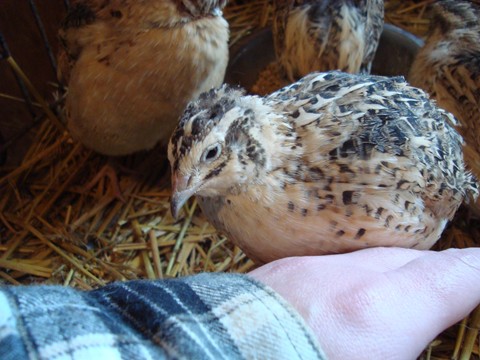
Ah eggs, I love eggs, they are part of what makes it feel like spring is just around the corner, I am seeing other bloggers posting about planting and working in their gardens, my land is still frozen solid at this time but the daylight is getting longer, and my just grown up latest batch of hens are starting to lay.. which means that I currently have a dozen fresh eggs coming in daily from them, plus the older hens, plus the ducks, the quail, the Turkey hens and a special surprise was waiting for me today.

Breakfast:Oatmeals

Lunch: Corn Beef, Mashed with gravy, and left Over Cabbage Salad

Dinner: Fittata with Onion, and Mixed Greens (Nettle, Spinach, Kale and Horseradish leaves from my garden last year) with fried Hashbrowns.

Drinks, Water, Tea and Hot Chocolate

So who laid that little white egg?? Do you like your gravy thin or thick? Do you like Milk Gravy with biscuits? Do you like Hollandise Sauce? What is your favorite sauce?

Posted in March Challange | 2 Comments

March 15th- Salt Brine and’s its kissing cousin pickling

We already covered Salt but as I move up and down bringing different jars out for my march live out of my pantry challange, I pass by so many things on the shelves that are made with Salt Brine.. As I worked on my charcutepalooza challange of making Corn Beef, once again I was playing with salty water, and the other day, I brined my bone in full chicken breasts for a whole 24 hours before roasting them off.

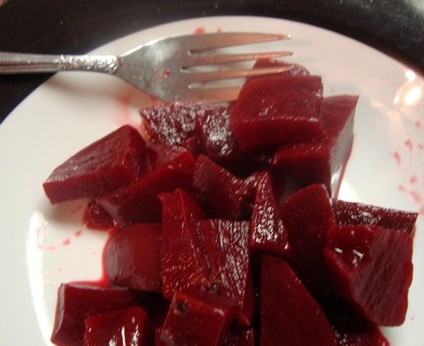
Honestly, If you can, the odds are so good that you also Pickle, that wonderful combo of salt/vinegar.. One of my favorites to Pickled Beets, now my momma passed down a trick on making the best “Port colored” Pickled Beets, you roast your beets first before skinning and dicing or slicing them, the color and flavor is a thing of beauty if you like beets.

Pickled Beets

Roast your beets, and then pop the skins off and dice or slice them, should have ten cups worth of cooked, roasted, skinned and diced beets.

This will make enough for 4 pints, 2 an half cups of white vinegar, 1 cup of water, 1 cup of sugar, Prepare your jars and lids, Take 3 tsbp of pickling spice an once stick of cinnamon broke in two and tie it up in cheesecloth to create a spice bag. In steel pot, put the the vinegar, water an suger together and bring to a boil, simmer for 15 min to infuse the spices.. then fill your jars with beets and fill with hot brine.. then process in a hot water bath for 30 min.

Breakfast- DH-Pancakes with fruit, FG-Red River with a bit of sheep milk.

Lunch-DH- Pasties, with trail mix and pears. FG-Pastie with cabbage salad.

Supper-Corned Beef, with a cabbage, cranberry, and pumpkin seed salad.

Drinks-Water, Tea

Extra’s.- Raison pie with a touch of cream.

So do you like Pickles? Sweet Pickles, Sour Pickles? Do you make and enjoy pickled beets, how about Pickled fish or eggs?? Do you like plain pickles or do you like to add spices, or garlic? What is your favorite type of cucumber to grow to make your own pickles?

Posted in Canning, March Challange | Leave a comment

Charcutepalooza March- Corned Beef

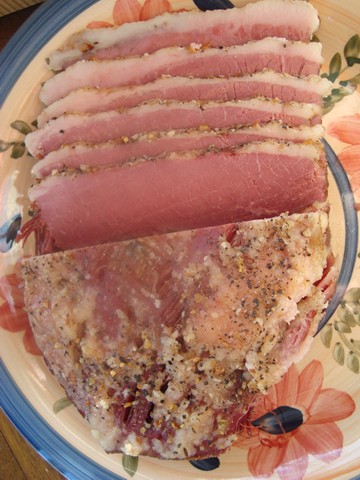
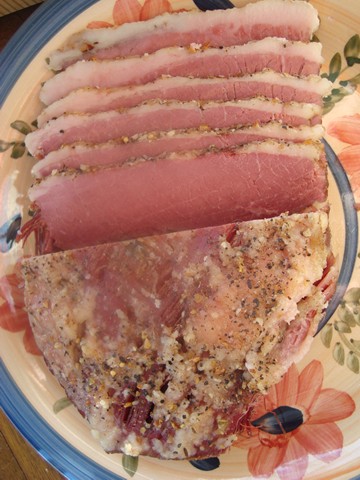
This month’s challange was to use a wet salt brine to make Corn Beef for St. Patricks Day.. I picked up a whole Brisket, and was quite surprised at just how fatty it was.. I felt that part of it would make wonderful corn beef, other parts, I felt would make better pot roast.

I made two corn beef, one small and one big.. I had never made homemade corn beef, but we do tend to buy it and have it at least once a month or more, I was very surprised at the color of the uncooked corned beef, but once it started simmering way, that lovely pink hue started and by the time it had finished it was a truly lovely color and fork tender. It was less salty then we are used to but it was more flavorful, we both had surprised O when we sampled it.. it was corn beef yes but it was so much more then that.. Our homemade version had hints of all the extra’s I have brined and pouched it in.. It was just wonderful, I can honestly say that I will be making our own from now on.

Now what to do with that tender, o so yummy Corn Beef..

I took one of my sweet green winter cabbages and slice long stripes, took a nice big onion and some fresh garlic, and peeled and diced it, a tiny dab of oil to cook them in, then in went the cabbage, I let it sit for a bit to get a layer of crispy brown, then flipped, I want it just slighly softened, I then put a tbsp or so of my best quality local butter to melt in, the cubed corn beef and flipped it around to spread the richness of the butter, and finish with a touch of salt/pepper and sesame seeds.

I know that this is not fancy or even creative but o my it was still heavenly..  My big Cornbeef is currently simmering in a pot this morning, and I can’t wait to see what we will use it for over the next couple days.

Posted in Charcuterie | 7 Comments

March 14th-Pastry and Pasties

As they say roll with it, I had a post almost finished for Yeast, and Basic Bread making, but for pictures and last min add-on’s.

Instead we are now doing Pastry and Pasties. So be it.

I put a pot of 4 peeled cubed Potato’s on to cook, in a frying pan I cut up into dices half a pd of our homemade bacon, with rind off, then Finely diced one very large onion, 2 garlic cloves and the whole middle with green of a celery bunch, cook till onion is clear then add your spices, I added in salt, pepper, more garlic power, lots of basil, nettle, and a bit of chili flakes. By then the potato’s where just tender, so drained and add in, mix together well, you want all the potato’s to be well seasoned.. taste a little, it should be quite strongly flavored at this point but the mix itself is fairly dry, no sauce is what I mean by that. Set aside.

Basic Pastry Dough

  • One pd Lard
  • 5 an half cups of All-purpose Flour
  • Pinch of salt
  • 2 tbsp of Vinager
  • 1 Fresh egg
  • Cold Water to finish off the cup.

Put your pd of lard, flour, and salt together in bowl, then get your wet together in its own bowl, add your vinegar, beaten egg and water, set aside. Go wash your hands, you can use a pastry cutter but I “need” to feel my dough to know when I have it right.

Here is when you are breaking up those big peices of fat, you can see that I am breaking it into four peices, three out the side and one out the top, this will create long flattish ribbons of fat to work with next

Now we are at all the flat ribbons, and you pick up your mix and rub it though your hand, the mix is in your hand, and your roller is your thumb over your fingers, its like a reverse milking motion. This will bring your fat down into crumble size.

Here is the finished look, very crumbed fat mixed thoughout your pastry.. but how to know if you got it right.. do the press test.. Pick up a handful and give it a gentle quick 2 second press, when you let go it should look in general like the mound below.

One poke and it will all fall back apart into the crumbles, now you know you have it.. Make a Well in the center and pour in your 1 cup liquid.. Give it its first stir and it should look like below..

Don’t look like much yet does it, but keep kneeding it just like you would bread, in that push and pull motion..

Now its starting to come together, keep mixing it till its a smooth ball and then let it have at least a ten min rest, if its summer, and my dough is soft, I will chill longer but in winter its not a issue.

Now after its rested, you are going to get your rolling setup, its very simple, you want a rolling pin, a bit of extra flour and your clean hands with a knife on the side for cutting.. Pull off a peice of dough (and cover the rest with a clean teatowel if you are going to take a good amount of time in between. Lightly flour dust your area, and start working your dough in a circle, sprinkle the dough with a touch of flour, and start rolling out, always move your dough so that you only do it one direction at a time with the rolling pin, otherwise its hard to keep the dough a circle. Roll out to your desired thinness.

Now you take some of your filling and place it in the middle of the dough, you can make a number of different shapes with it, squares or pop-over shapes or rounds.. I made a few different to show you. The one below was made into a standard Calzone type shape.

But this is the shape that I think takes it from being a pasties to being something special to serve someone and it takes the same amount of time to make, the flower on the top will always be a bit different depending on how the dough rolled out, making each one special per plate. Make sure your make your flowers thin enough that they can cook the whole way though.

At this point, you can egg wash them if you want them a dark golden brown like at the store, I am not going to, it will mean a lighter done color but that is fine with me. Bake in oven at 350 till golden brown on the bottom and lightly brown on the top, about 20-25 min, cool on a wire rack, can be served hot from the oven, eaten cold in hand or rewarmed.

Ideally served with a nice green salad the side.. What do you think.. Aren’t they pretty, would you like to come for dinner and be served up one these?

Need a Dessert of course..

Old Fashion Raison Pie

  • 2 cups raison
  • 2 cups water
  • 1/2 cup packed brown sugar
  • Pinch of salt
  • 1 tsp of cinnanom
  • 2 Tb of corn starch with a bit of cold water to mix
  • 1 tb of lemon or lime juice
  • 1 tb of butter.

Put your raison’s and water on to cook, bring to boil and simmer for 5 min, then add sugar, salt, and premixed corn starch, stir often to prevent lumping, cook till thick and clear, remove from heat, put in lime juice and butter, stir till butter is fully melted and mix though. I have included a photo what the filling will look like. Pour into a 8 inch pie pan with crust on bottom, top with second crust, and don’t forget your steam holes on the top, flute your edges and into the oven to bake.. This pie should not be served hot, Slice and serve cold, with or without a dollop of whip cream.

Pie Pastry for a top and bottom. Bake at 350 till golden brown and filling bubbling.

Breakfast:Leftover Pancakes

Lunch-DH’ Leftover Pasta, with canned Pears, and trail mix, FG- Fresh Pastie from the oven.

Supper: Bacon, potato Pasties with a cabbage side salad with cranberries and pumpkin seed.

So do you ever make Pasties? or you buy them? what is your favorite filling? Do you ever make Raison Pie?

Posted in March Challange | 8 Comments

March 13th-Rice

Black Rice, Red Rice, Brown Rice and Wild Rice, this has to be my favorite mix ever. If I am eating just one kind, it tends to be grown in the USA Red Rice.

Don’t you just love a food that you can take in its dry state and with cooking create something 3x the volume. Whole Rice is a very healthy food, if you don’t like brown rice, I would highly recommend trying some of the different kinds available, I love! wild rice, but I don’t like the price tag that goes with it.. Red Rice is as close as I can find to getting that firm rice with a nutty flavor that wild rice has but with a much lower price tag, I have never found red rice as cheaply as I can find plain white rice but I can find it cheaper or equal in price to good quality Uncle Bens Long Grain Rice.

I don’t consider Minute Rice to even be food, its like eating wonder bread and thinking that that its a healthy food.. Good quality whole grain rice is like the difference between a good whole grain bread vs cheap white bread. They are a world apart.

I don’t own a rice cooker but I do have what I call my rice pot, its a hand me down, I got it from my momma when was 19 and its a small brown bean pot, It makes a perfect pot of rice if done correctly, at its max it will hold 2 cups of raw rice, or 6 cups of cooked rice

2 cups of rice, 6 cups of water, a pat of butter, a bit of salt, and typically some dried garlic and herbs. Always remember to wash your rice first and to do so until the water runs clear before putting it in the dish. I always start with cold water, and then into a oven at 350 for 2 to 3 hours depending on the kind of rice being cooked.

FG Basic Rice Dish

  • One Pot of Cooked Rice- Listed Above
  • One small onion- Peeled, Finely diced
  • One Clove of Garlic-Peeled, Finely diced
  • One stock of Celery-Washed, sliced in half and finely Diced
  • Then I just start looking in the fridge for possable extra’s like
  • Mushrooms
  • Peppers
  • Cabbage
  • Green Onions
  • carrot
  • Raddish
  • Fresh Chopped Greens

Once I have what I am going to use as my veggies, I put a little oil in my cast iron and cook up the onion and garlic, then add the rest till just softened, and then typically add a pat of butter, and then mix that with my rice and serve.

Breakfast-Homemade Bacon, Herbed Oven Fries, Eggs with Nettle and Pinnapple Smoothie

Lunch-(which was the heavy meal of the day) was Herbed Oven Fries, Lamb Hamburger, mushrooms and onion, with the leftover gravy from the chicken dinner.

Supper-Pancakes

Drinks-Water, Tea, Hot Chocolate.

So what is your favorite kind of Rice? Have you tried Red Rice? What’s your favorite way of serving it? Do you make old fashioned Rice pudding?

Posted in March Challange | 6 Comments