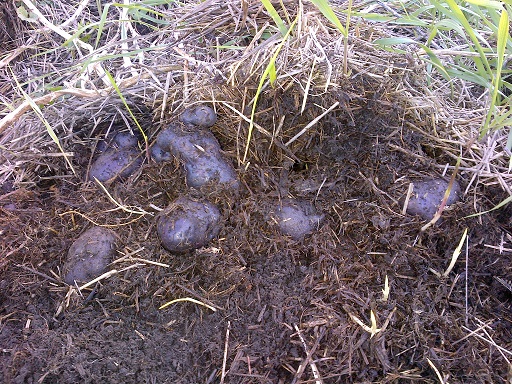
Growing in Straw potato`s this year.. All new spuds kinds to us.. As you know.. Lots of rain this year..

ROW 1: “ALASKAN (?)” – White w/ red skin
The row produced 63 lbs, with a reasonable size range. Shape was generally satisfactory with few “nodules”. Only minor issues with rot and pestilence were noted, with no UV damage. The potatoes were generally found at the soil/straw interface, but a number were wholly within straw and occasionally were found after chunks of straw had been discarded. It may not be a coincidence that this variety had the most individual plants and produced the most weight.
we planted 5 pounds, our yield was 12.6x, pretty good.
ROW 2 – “ALL BLUE” – Blue w/ purple skin
The row produced 48 lbs, with a reasonable size range. Shape was generally satisfactory, with a number of lengthy potatoes that would be well suited for french fry making. Only minor issues with rot and pestilence were noted, with no UV damage (note that blue pigmentation is supposed to reduce UV damage anyway). Potatoes were generally found at the soil/straw interface but rare examples were wholly within dirt. Redigging the row might produce a few additional spuds. The color of the potatoes did make it a bit more of a challenge to find in the dark material.
Online source indicates a yield of 10x – 15x is possible under optimal conditions. we planted 5 lbs, we got a yield of 9.6x, good.
ROW 3: “ALL RED” – Red w/ red skin
This was a partial row with only seven plants. It produced 41 lbs of good potatoes and 3 lbs of rejects, with a mix of rot, pestilence, and suspected UV damage (color was creamy, rather than green). Size and shape were mostly good, but the hills were generally “stuffed” and projecting to surface with small potatoes. A few odd shapes were observed. It’s thought that these hills were planted with whole potatoes and thus might’ve done better if the seeds had been split before planting.
Online source indicates a yield of 10x to 15x is possible under optimal conditions. we planted 5 lbs, we got a yield of 8.8x, good.
ROW 3/4: “DUKE OF YORK” – White w/ yellow skin
This was an oversized row and a half that produced 34 lbs of good potatoes and 17 lbs of bad potatoes. Rot, pestilence, and particularly UV damage were noted, even in potatoes that appeared to have been covered; the straw may have still permitted light in. Shapes often included nodules, and even the accepted potatoes often have rough looking skin. Some hills projected to the surface, contributing to losses.
It’s possible seeds needed to be further split or more deeply planted, but given how the other three varieties did, and that the total weight harvested was comparable, I’m inclined to think it’s just not as suitable a variety for this sort of planting. Some online reading characterizes this variety as “early” so we may also have lost simply because they should have been harvested sooner than was done.
we planted 5 lbs, our yield was 10.2x, which is good


 Just another Day on the Farm
Nice job!
Thanks Hubby did a great job on it and a very nice write up as well to share
I emptied my potato bin from the roof yesterday – it was a mix of straw and soil and I got 10 potatoes. Not pounds, 10 individual potatoes. Which beats the year I got exact 3, but not by much. Most of them area good size, and I got a few of each colour, yellow and purple. So it’s possible to grow them on the roof, but I guess I need to add more layers or more plants.
Thanks so much for the impute heather, good to know that you can grow on the roof but it does sound like you need to do some kind of modifiy to get it really start to produce
We didn’t weigh them. We got 3 very full commercial ice cream buckets, plus a few I grabbed earlier. I should have hilled them, which I didn’t do. Growing in straw was bad for us because the chickens got at them.
On the local gardening group there were a number of folks that didn`t have a good luck on growing In the straw but it did well for use this, with 9x to 18x return for what was planted, nothing at all wrong with those numbers for sure
Do you have a potato bug problem at all? What do you do to get rid of them? When I grew at the community garden last year it was pretty infested, I wanted to go without chemicals but I had to save my plants so sprayed those bugs and the plants were ok, until a second wave of them came thru…plus not everyone uses the same method to get rid of the bugs, so they had different areas to eat.
We do have potato bugs, and we do hand picking of them at least a few times a year, I also use a manure spray (for in town the soap and water spray in the bottle is the same idea, you are coating the plant with something that they will not want to eat the leave for) I also have enough land that I can really move the grow areas from year to year, and I use trap plants.. which really work if you can afford to give the space for them.
http://www.toxicfreenc.org/organicgardening/potato_beetles.html#.VOdiZ-k5DSw
http://www.vegetablegardener.com/item/5301/control-colorado-potato-beetle-with-a-mix-of-strategies
So given the fact that you are in a community garden and you would have trouble with moving them around, I would use the other folks potato plantings as crap crops and hand pick.. plant either a few really early potatos and then remove them yourself and burn if you can, otherwise garbage bag them as trap crop for yourself or plant around what the others did last year.. if you do not know what they are planting and you are on good terms ask them.. are you planting Yukon Gold this year etc.. they do not need to know why you want their type but then you can look at the grow dates and plan around it.. hope that helps a bit
Pingback: Seed Potato’s are ordered for 2016 | Just another Day on the Farm
Pingback: Wednesday Flash back.. | Just another Day on the Farm
Pingback: Potato Harvest Overview 2024 | Just another Day on the Farm