
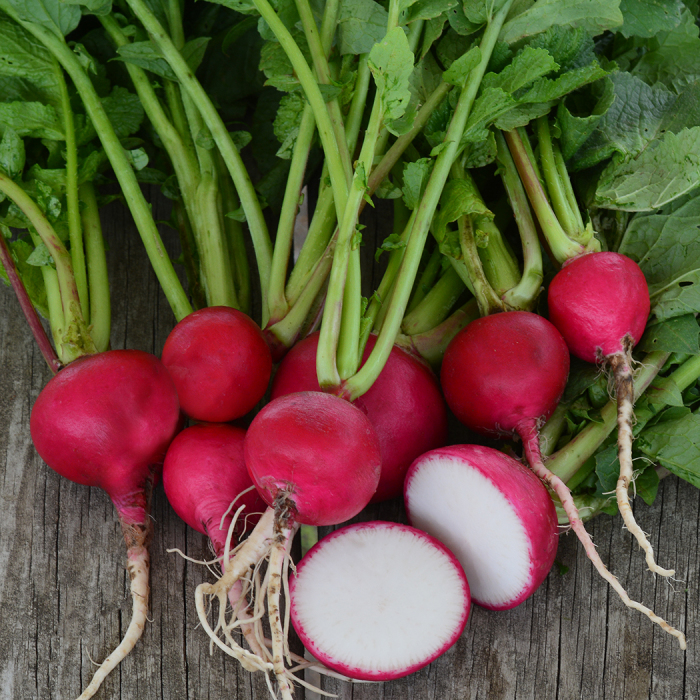
German Giant Radish has been added to my radish growing this year for a couple of reasons. Ah Radishes, one of the fastest growing crops you can get in the garden. Lets talk about this amazing plant, you have summer radish, which will give you sweeter end results in cooler spring/fall plantings, spicy hotter versions in the heat of summer but are still ideal to be planted into shade spots and then you have winter radishes that are bigger and will extend into early frosts
In Canada Radishes are a very common veggie, when i was growing up, you had small round red with white flesh and depending on when harvested, they could be mild or hot! or HOT! Eaten whole, maybe with a bit of salt or dipped into a dressing or sliced into rounds and added to a salad.
Boy, were we missing out, i still remember being the first time i was served roasted hot radishes, it was in Helsinki, in Finland that first got to try so many different ways that radish could be prepared and i have been hooked. Then came our local food share program and suddenly winter radish became something that i could get regular, why i can’t buy Daikon everywhere is beyond me, the closest store that carries it local to me regular year round is 45 to 60 min away depending on traffic

I am growing six different types of radish on the farm this year, I will be growing
Cherry Bells “Here is a delightful looking summer radish with 2.5-5 cm diameter cherry-red roots that have a pleasing, mild flavoured white flesh. Cherry Belle holds great potential for extending the season as it forces well under glass and maintains its superior eating quality for a long time. An ideal variety for late spring and early summer plantings. Introduced in 1949.”
Easter Egg “This is a colourful addition to the radish family. Stunning intense shades of white, red, purple, pink and violet roots make this tasty radish a visual, as well as culinary, treat. The roots are large and smooth skinned, flesh is firm and crisp”
French Breakfast “An older variety grown since at least the late 1870’s. Produces rich scarlet red roots with white tips that are crisp, mild and surprisingly sweet. A real favorite that has stood the test of time!
New to the farm and to me are
Crimson Giant : H. A. Dreer, in a 1910 booklet that they published, had this to say about ‘Crimson Giant’ radishes, “This variety is suitable both for forcing or early planting out of doors. A remarkable feature of this Radish is that it will grow double the size of other round red forcing Radishes and still remain solid. The ordinary forcing Radish, after growing to the size of two or three inches in circumference, becomes pithy, while the Crimson Giant will grow to six and seven inches in circumference and still remain solid and juicy, free from all signs of becoming soft.”
an
German Giant ” German Giant is a solid red colored, round shaped, radish with crisp, white, and pungent flesh. It resists getting woody or spongy and can be harvested from golf ball size on up to about the size of a cue ball. To achieve the larger sized radishes, provide them ample space by thinning the seedlings to at least one-inch apart.”
and of course i will be growing Daikon Radish a winter radish, i will do a totally different post on tillage radish, which i have brought in a whole pound of seed on for use to help in my new garden area that has some of the worst soil i have ever found on the farm!
They can be grown in pots, they can be grown in flower beds, tucked here and there and replanted every two weeks for a growing supply, no one is going to notice if you pop a radish seed in and around your flowers, it will just be green undergrowth to the person walking by.
Radishes should be on your garden grow list and your seed saving list! One of the fastest growing plants to get food on the plate, pickled radish works amazingly well for preserving, Almost everything about them is edible, leaves, radish ball root, seed pods and the seeds can be ground themselves as well as sprouted with ease
While having been grown globally since the time of Egyptian and Roman times and most likely before that, it is a outstanding plant that can be grown in cooler climates to great success! Time to explore its many choices and add some new types to your garden plans!
Globally Radish can be grown for their roots, for their seed oil, for their green tops, they come in many different colors, sizes ranging from tiny to the size of basketballs. They are a powerhouse of a food!
A half-cup serving of raw radish slices (about 58 grams)
- Calories: 9.3
- Total Carbohydrates: 2 g
- Fiber: 0.9 g
- Sugar: 1.1 g
- Total Fat: 0.1 g
- Saturated Fat: 0.02 g
- Polyunsaturated Fat: 0.03 g
- Monounsaturated Fat: 0.01 g
- Trans Fat: 0 g
- Protein: 0.4 g
- Sodium: 22.6 mg (1% DV*)
- Vitamin C: 8.6 mg (10% DV)
- Folate: 14.5 mcg (4% DV)
- Potassium: 135 mg (3% DV)
*Daily Value: Percentages are based on a diet of 2,000 calories a day.
What types of Radish are you growing this year? Do you eat Radishes regular in your meals? Do you eat them fresh? Fermented? Pickled? Roasted? What is your favorite type? Do you only eat summer types or do also use winter type? What is your favorite way to eat them?


 Just another Day on the Farm