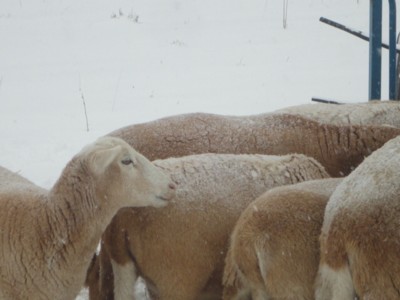
 Woke up to old man winter having arrived in the night, the world is white, cool and with a nip to the nose. The sheep had to be called out of the barn for their fresh warm morning watering, they came single file and once having their drinks, went and pawed into the hay, with the look of.. this again!
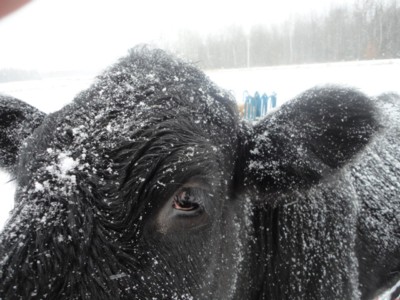 Snow never seems to mind the critters while they are out eating their hay, but I do think its pretty, good thing those winter coats have been coming in..
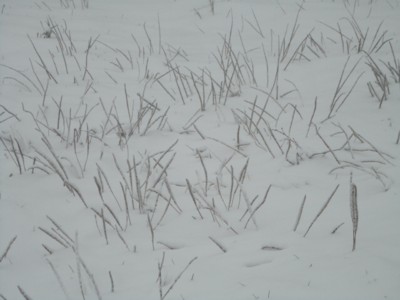
Boy, its a good thing I pulled those beets when I did, I don’t know if its just me but the plantain growing spot looked just like a little abstract watercolor painting to me this morning..
Well, DH’s first plane has been delayed, which means that whole day has been changed, and its all up in the air at this time, I was so looking forward to having my man home with me soon, and the snow, colds and the need for quiet down time has taken my girls day from me this week, on the other hand, the ducks are snow bathing, which always cracks me up and raises my spirits, and Blackmore’s Knights Chirstmas C.D. is playing, filling the house with joyful sounds..


 Just another Day on the Farm
I love me some christmas music- got a link for the Blackmore’s Knights?
Still no snow here so my beets, carrots and one crazy tomato are still outside.
Hi Callie,
Blackmore’s Knight is kind of a mix between New Age, Old Celt and Middle Age music, depending on the C.D.
Here is a link on amazon.ca to the Winter Carols that I was listening to..
says they are out of stock right now, but it would give you a good starting point..
One of my favorite CD’s of their is Fires at Midnight, in fact I think I am going to go put it own right now! Let me know what you think of the band, and if they hit the spot for you.
I don’t know if you could find a copy of this Xmas C.D. or not but if you ever come across one called the Northern Ramblers, they were from Iqaluit with a mix from East and West, its excellent and has a trure canadian and northern feel to it.
Sorry, put this in the wrong spot the first time…
You can find this one On YouTube: “Fires at Midnight” 09 Chicago part 4 (pirated vid, so not great quality; but shows what they’re about with music and costumes…)
They remind me a lot of Lorena McKennitt’s musical style (speaking of Canadian musicians). She also has some great Christmas albums. My personal favourite of all her songs is “The Highwayman”. Such a beautifully romantic, yet terribly sad story.
On YouTube: “Fires at Midnight” Chicago part 4 (pirated vid, so not great quality; but shows what they’re about with music and costumes…)
They remind me of Lorena McKennitt’s musical style (speaking of Canadian musicians). She also has some great Christmas albums. My personal favourite of all her songs is “The Highwayman”. Such a beautifully romantic, yet terribly sad story.
A yes, They are somewhat like Lorena, she is awesome, I have most if not all of her C.D.’s and have seen her in concert three times to date, the first one being on my 19th birthday, so I have been listening to her for at least 20 years..
What she did with the highwayman was truly artwork, and you either like it or not, I have always liked the version she created but my one girlfriend H, never did, she found it to fast/upbeat for the how she heard the poem in her mind and heart, so it didn’t hit the right cord for her..
Hah! “The Highwayman” is one of the poems I memorised in grade school [along with “(The Wreck of) The Steam Ship Puffin”]. LOVE how she put verse to music.
Merry Christmas FarmGal! (Well, looks like it; ) Read your post and immediately went to YouTube for context on Blackmore’s Night “Winter Carols” Album… What a lovely olde English sound they have. Do you happen to remember where you got your copy?
You mentioned your “plantain growing spot”…
Does that mean you make something regularly with plantain for medicinal/culinary use? I know, I know… SO many questions. : D
I know, its a perfect christmas morning snow, and boy if Dh was around, I tell ya, at least one snowball would have had to be made 😉
I got my copy from Amazon, it was cheaper then at the local store in the mall in the city about 40 min, so that is were I got it at.
Yes, I do grow them, first because the rabbits love it, and I feed them and the chickens fresh greens over the course of the spring/summer/fall but also because I use the juice from the crushed stems in creams or salves.
http://botanical.com/botanical/mgmh/p/placom43.html
“Medicinal Action and Properties—Refrigerant, diuretic, deobstruent and somewhat astringent. Has been used in inflammation of the skin, malignant ulcers, intermittent fever, etc., and as a vulnerary, and externally as a stimulant application to sores. Applied to a bleeding surface, the leaves are of some value in arresting haemorrhage, but they are useless in internal haemorrhage, although they were formerly used for bleeding of the lungs and stomach, consumption and dysentery. The fresh leaves are applied whole or bruised in the form of a poultice. Rubbed on parts of the body stung by insects, nettles, etc., or as an application to burns and scalds, the leaves will afford relief and will stay the bleeding of minor wounds.
Fluid extract: dose, 1/2 to 1 drachm.
In the Highlands the Plantain is still called ‘Slan-lus,’ or plant of healing, from a firm belief in its healing virtues.
The Broad-leaved Plantain seems to have followed the migrations of our colonists to every part of the world, and in both America and New Zealand it has been called by the aborigines the ‘Englishman’s Foot’ (or the White Man’s Foot), for wherever the English have taken possession of the soil the Plantain springs up. Longfellow refers to this in ‘Hiawatha.’
Our Saxon ancestors esteemed it highly and in the old Lacnunga the Weybroed is mentioned as one of nine sacred herbs. In this most ancient source of Anglo-Saxon medicine, we find this ‘salve for flying venom’:
‘Take a handful of hammer wort and a handful of maythe (chamomile) and a handful of waybroad and roots of water dock, seek those which will float, and one eggshell full of clean honey, then take clean butter, let him who will help to work up the salve, melt it thrice: let one sing a mass over the worts, before they are put together and the salve is wrought up.
Some of the recipes for ointments in which Plantain is an ingredient have lingered to the present day. Lady Northcote, in The Book of Herbs (1903), mentions an ointment made by an old woman in Exeter that up to her death about twenty years ago was in much request. It was made from Southernwood, Plantain leaves, Black Currant leaves, Elder buds, Angelica and Parsley, chopped, pounded and simmered with clarified butter and was considered most useful for burns or raw surfaces. A most excellent ointment can also be made from Pilewort (Celandine), Elder buds, Houseleek and the Broad Plantain leaf.
Decoctions of Plantain entered into almost every old remedy, and it was boiled with Docks, Comfrey and a variety of flowers.
A decoction of Plantain was considered good in disorders of the kidneys, and the root, powdered, in complaints of the bowels. The expressed juice was recommended for spitting of blood and piles. Boyle recommends an electuary made of fresh Comfrey roots, juice of Plantain and sugar as very efficacious in spitting of blood. Plantain juice mixed with lemon juice was judged an excellent diuretic. The powdered dried leaves, taken in drink, were thought to destroy worms.
To prepare a plain infusion, still recommended in herbal medicine for diarrhoea and piles, pour 1 pint of boiling water on 1 OZ. of the herb, stand in a warm place for 20 minutes, afterwards strain and let cool. Take a wineglassful to half a teacupful three or four times a day.
The small mucilaginous seeds have been employed as a substitute for linseed. For ‘thrush’ they are recommended as most useful, 1 OZ. of seeds to be boiled in 1 1/2 pint of water down to a pint, the liquid then made into a syrup with sugar and honey and given to the child in tablespoonful doses, three or four times daily.
The seeds are relished by most small birds and quantities of the ripe spikes are gathered near London for the supply of cage birds.