
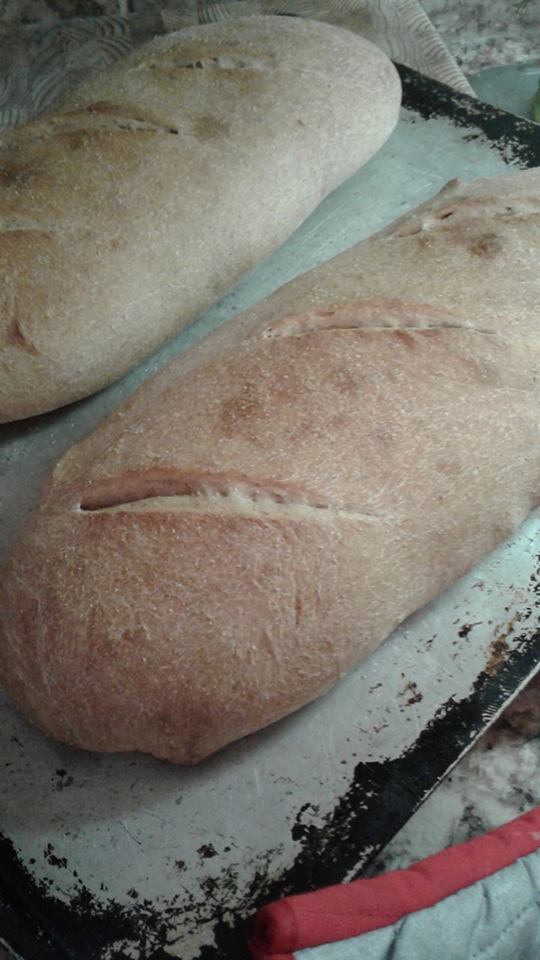
The National Loaf
From: Ministry of Food – Jane Fearnley Whittingstall
Makes two loaves
1 ½ lb wholemeal bread flour*
1 ½ tbsp salt
1 ½ tbsp dried yeast
1 tsp honey or treacle (two teaspoons)
450 ml tepid water (about 2 cups)
1, Mix together all the ingredients and knead for about 10 minutes until you have a soft dough. Place the dough in an oiled bowl, cover with a dish towel, and leave until dough has doubled in size (around 2 hours).
2. Knock back the dough, give a short knead then cut into two equal pieces. Place in 1.5 litre loaf tins (8 X 4 X 3 loaf pans), allow to rise for a further 2 hours.
3. Pre-heat oven to 200°C (400° F) then bake loaves for 30 min. To test the loaves, turn them out of their tins and give the base a tap; if it sounds hollow, they are ready. Allow to cool on a wire rack. *use a food scale for best results
Well, I made it and like those during wartime, I don’t like it.. bla.. its a dull thick bread.. Hubby said and I quote “chewy” I normally make all our own bread and I like heavy breads so I am not sure why this one did not work in the way I thought it would?
I think its because I always use milk, eggs and of course fat in my breads. I find this bread to go stale very fast. I can see what it would be used in a lot of way in meals to not so much stretch this bread as to try and cover some of the blandness of it.
As far as I can see as long as I use the whole wheat bread and keep in my rations I can make my own breads in the challenge and that is just what I am going to do on my next baking day.


 Just another Day on the Farm
No fat would definitely make a difference……I ‘think’ fat was rationed back then as well?
Very much so was fat rationed, but I would rather go without bread most of the time then eat something I really don’t care for. I am interesting in seeing if I can make recipes that make it taste better that way.
I think if I added in even one duck egg, I would find that the fat in the egg would be enough to really change the texture
I make a whole wheat bread at home, except it is a sourdough…if you omit the yeast and use a sourdough starter instead the bread will keep better. If I had a recipe written out, I would share, but I don’t have weights for all the ingredients 🙂
Thanks Amanda, you are right.. no reason I can not use my sour dough starter on the next loafs. I was just wanted to make at least one batch as pure as possible in keeping with trying it.
Thank you so much for sharing this recipe. I have been baking for decades, and even for a while, was a professional baker. I started this recipe in good faith, but knowing what I do about baking bread, this recipe has issues. I am wondering how you came across this recipe? With the same ingredients, you can make a far better loaf. It does not need fat. The reasons it is heavy include: The yeast is not proofed first with the water (and optionally the honey). Too much salt, and the salt added in the beginning (salt retards yeast action). Too much flour for the water (dough should be very moist and even a bit sticky). No mention of kneading until the dough changes, either. Time is great, but not as good of an indicator as when you can “windowpane.” Kneading is not mixing. It is for the purpose of setting up protein chains in the bread, which are what act as scaffolding to let the dough rise as the yeast multiplies. For anyone reading this, try it again but with different organization of the technique, and with the salt in teaspoons, not tablespoons. Proof the yeast in the water first until you see action. I like to do it for more than five minutes, usually… until I see it look like it is moving, almost like it is boiling a bit. Then add the honey if you have not already, and start adding the flour gradually, but don’t add it all if it doesn’t need it (it won’t). Add flour only until it is coming together as a ball without sticking to the table or the bowl, and then stop. Once the flour is incorporated, then add the salt. Knead until you can windowpane the dough between your fingers (stretching it thin enough that you can see light through it without it tearing too much). Then it is kneaded. When you rise, rise until double and NOT until triple. Over rising the first rise can make for a heavier bread. That should get you through with much better and tastier results. Good luck!
Hello, I fully agree, I bake a lot and this recipe like most recipes from the time , assume you know what you are doing, I copied what was written directly including giving credit, it was in one of my war time books where they have copies of what was printed at the time.. your tips and advnice are excellent, Having said that, I did try this bread a few times and we still do not like it, it was interesting to read about it and try it, but for our home, we will continue to make a selection of breads, flat breads, buns and so on that we enjoy.