
Just one of my coming 2013 garden experments.. massive mangels for critter feed!
“Red Mammoth Fodder Beet (100 days)
Fodder beets have been around since the 1400s if not earlier. These beets were prized as nutritious animal feed that was easy to store. Fodder beets are hardy, adaptable and palatable. They are ideal for planting in late summer for use as a winter and spring crop.
Red Mammoth Mangel Beets produce an incredible mass of edible beet leaves and a large root up to 20#s or more in size! These beets prefer deeply tilled, free draining, sandy soil to achieve full size. Simply allow your animals to graze on the tops, cut the tops for feeding or harvest the root.
1940 Oscar H. Will Pure Seed Book says… “The heaviest yielder and most popular of all Mangels the light red roots are pinkish fleshed and grow well out of the ground. Yields run as high as fifty tons to the acre.”
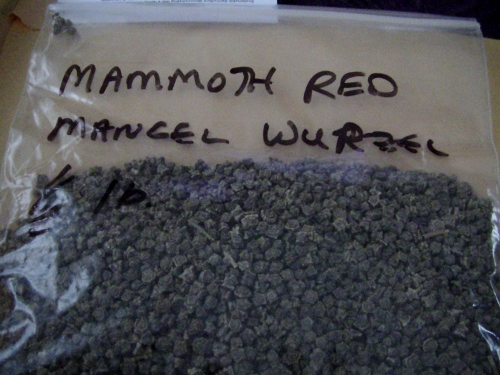
Hard to believe that these seeds, they are good size to be fair are going to grow to upwards of 20 pds each, and of course I want to keep some and have them go to seed so that I can keep back my own..
This pic is from the net.. If I can do half as well as this old timer did in the 1920’s I will be a very happy farmgal indeed! I intend to do a very early small spring crop, with most being a later planted crop for winter storage.



 Just another Day on the Farm
Wow! That’s a huge beet! How many would you think you’d have to grow for your animals?
I am planning on starting out with 1/8th to 1/4th of a acre, we will see how it grows, in order to poundage, I don’t expect to get the max yield as I will breaking new ground for this, turning from pasture to garden.
Where did you order your seed? I know one of the bloggers I follow in Oregon grows these for her dairy cow, but I haven’t found any seed in British Columbia. Let me know, Thanks!
http://wallacesprings.blogspot.ca/2013/02/mangel-wurzels-feed-that-monsanto-hasnt.html
they are canadian
Hi ~ thanx for the write up. Yes we are Canadian and yes we do still have some seed available. ivan
Thanks- I’ve bookmarked the page! I don’t currently have large livestock, and *do* have a big problem with root maggots, but when I get my acreage……. 🙂
Bet that’ll be fun digging them; )
They say (and it appears to be alot of thems, so i hope they are right) that a large portion of the root will grow up in the air, helping making that digging easier but also explaining why unlike regular beets, you have to get them out and cured before the first major hard frost.. that makes sense to me if they are going to have six plus inches out of the ground, I have seen at least a couple photos that showed eight to nine inchs overgrown with a foot and half underground.
Hi, I’m just wondering if you was successful in growing these beets. I have a growing number of livestock and i’m looking for better ways to feed them