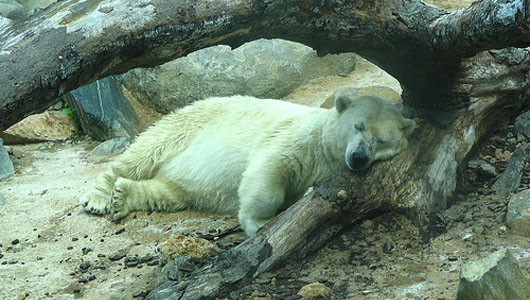
The first Osnabruck “grolar bears” were the children of a female brown bear and, evidently, a male polar bear. Born in 2004, the cubs were the first hybrids to show up after nearly 25 years of the two species’ cohabitating. Researchers observed the cubs and found that the hybrids are a bit smaller than the polar bears, have long necks like their polar parents, but have the shoulder humps typical of brown bears. Other features include thicker heads (like grizzlies), visible tails (like polars), and blended feet — partially insulated with hair like the polar bear, partly long-toed like the grizzly.
Hunters from the village of Ulukhaktok, N.W.T. knew there was something different about the polar bear they were stalking but couldn’t put their finger on it. It was far more aggressive than anything they were used to. They even called off the dog for fear the large white mammal would kill it. On closer inspection after it was shot and killed, it turned out not to be an ordinary polar bear but one that was a cross between a polar bear and a grizzly, unofficial known as “grolar bear” and “pizzly.”
“The first hybrid we had ever seen around here a few years ago was pretty nasty. They (hunters) usually stalk the polar bear using a dog but this bear was so aggressive they couldn’t use a dog on them. It was too dangerous,” Robert Kuptana, who lives in the western Arctic hamlet of about 400 people on Victoria Island, told the Toronto StarFriday.
Over the years as grizzly bears have wandered further north following the Caribou herd, the hybrid variety has become more common, the 69-year-old Kuptana said, adding that just 10 days ago, a hunter from the village, Pat Ekpakohak, and his two grandchildren killed three of them. “One is pure white, one is partly dark and the other is fairly dark brown and the top part is white,” said Kuptana, who took a picture of the skins. Polar bear and grizzly habitat overlaps in the western Canadian Arctic around the Beaufort Sea. Grizzlies are known to occasionally to go out on the ice in the spring to feed on seals killed by polar bears, according to the Canadian Wildlife Service.
A DNA test conducted by the Wildlife Genetics International in British Columbia on a bear shot and killed by an American hunter in 2006 confirmed it was a hybrid, making it the first documented case in the wild. Ian Stirling, a research scientist and polar bear expert with the Canadian Wildlife Service in Edmonton, said in an interview with National Geographic that the hybrid was “definitely not” a sign of climate change. Andrew Derocher, a professor of biological sciences at the University of Alberta, is in Ulukhaktok, where he is doing polar bear research and saw the skins from the three hybrids. He told the Star, “It seems to me they are getting a lot more common, at least in this part of the Arctic. “I think the story here . . . is that the number of grizzly bears on Victoria Island has increased quite markedly over the last 20 years. And part of that might be related to changing environmental conditions up here. It’s a bit warmer and it’s quite clear the grizzly bears are well-established here now and, of course, there is a healthy population of polar bears around,” he said. David Paetkau, president of Wildlife Genetics International, based in Nelson. B.C., told the Star it was a “quirky” development that can’t be totally explained and that he was only interested in talking about substantive work that his firm does.
So here is my question, is it in fact a mule or can these hybreed make babies, and if so can they cross back and forth on which both breeds… so if the first DNA proven bear was in 2006 but the hunters can take four in a matter of a two weeks, there has to be alot more of them up there on that island and if that can happen there and in the zoo, it can certianly happen in other areas if climate change effects the plant and animal growth, its like the killer whales moving in ever increasing numbers up in the Canada north do to the changing sea ice.. hmmm, going to have to follow this one as more info becomes available.. Now we have half wolf-half coyotes in ontario/quebec within proven DNA moving back down into the upper eastern states with the daughter mix outpacing their parent species, wonder if that is what we will slowly see happen in regards to this mix, the best of both mixed into one package..


 Just another Day on the Farm
Hm,mm “Survival of the fittest” did you say?
Don’t know about you, but I’m tired of hearing that something “can’t be true” just because someone doesn’t have “scientific proof” to make it so. Mother Nature has done (and will continue to do) whatever works to fit the scenario for a very long time – without the benefit of “scientific proof” (and adapt or die is pretty strong encouragement, eh? ; )
Adapt or die will get it done everytime! 🙂 but in truth I think most of the time, its a slower process then that, but if they are right at all about the many changes that this old world has seen in terms of cold/hot and everything in the middle, then its quite possable that this crossing has happened at some other point and time and there is just enough genes left from that mix thousands of years ago to find the right clicking point in the breeding bears of today and faster then you can say.. wow.. mixed cubs are born from the right parents ..
The sheep all ran together and stared out with total flight freak and while I might be having a rained in day (way to much time to read and play on the computer today) checked it out in time to see two big coy-wolf or coy-dog (shepard cross’s) moving across the big field and stopped to have a look at my sheep flock..ahhh.. really! hope they are just moving though, we have a pack of coyotes that call my area home and they are very respectful of fences and livestock, and never bother my sheep, I want them to stay.. sheez those mix’s are bigger and they have a different chest and head build from a proper coyote.. guess I had better lock the sheep down for the night, and I turned out the cow who will happly take on the hounds if given even a tiny chance to do so..
Fate that I was just talking about them and then they appear..hmm wish it was so but they have been seen in the area enough to be talked about, I have seen them a few times from a longer distance and never so close to my own farm but I knew they were around..
I like your hypothesis on the “throwback” genes; that would explain a lot.
But these cross bred coyote mixes especially those with domestic dogs are most worrisome to me; coyotes have little enough fear of man as it is. There’s a big one hanging around my parents’ farm – in broad daylight even! Unfortunately, I guess it’s time to give them a reason to be wary again.
Ya, I talked to the UPS guy, and he said there is a whole pack of them in the forest, he lives on the other side, but given how big a range can be.. perhaps this is a mated pair on the move, I am sure it was a male/female set.. I made a couple calls to alert the farmers in the area that have young calves out in the fields to keep an eye out..
Well, according to Wiki, they’ve found a second-generation – DNA tests showed that the mother was a hybrid and the father was a grizzly.
What a world we’re leaving our kids …..
Cool, they are fertie, a true daughter species.. that’s amazing!